Winter 2026
Bunker Hill Hero
Salem Poor, a Black soldier, was singled out for his bravery in one of the first clashes of the American Revolution, but his role in the battle is a mystery that historians have been wondering about for more than 200 years.
On the morning of June 17, 1775, after a night spent shoveling dirt to build fortifications just southeast of Bunker Hill in Charlestown, Massachusetts, provincial militias were beset by cannon fire from British Navy ships. By that afternoon, 2,400 British soldiers sent from Boston — then a separate city — had advanced on the peninsula, and soon most of Charlestown was in flames. Two months after the first bloodshed of the American Revolutionary War at Lexington and Concord, tensions had boiled over again.
Although the Colonials would lose the Battle of Bunker Hill — the site of which is now part of Boston National Historical Park and a stop on the city’s Freedom Trail — the conflict resulted in significant casualties on the British side. More than 1,000 were killed or wounded (as opposed to around 450 militiamen), a toll that proved the mettle of the Continental Army and solidified the fight for American independence.
Amid the fray of the day’s battle, Salem Poor, a formerly enslaved man who had purchased his freedom several years prior, stood out for his poise and valor. As British forces made their third charge on the redoubt, Poor’s unit came under heavy fire and returned shots at the redcoats as it retreated.
Six months later, 14 regimental officers signed a petition to recognize Poor as a “brave and gallant soldier” who had “behaved like an experienced officer,” and sent it to the Colony’s general court. No other soldier in the battle was given such an honor.
What Poor did to earn that praise, however, is still a mystery. If the officers were effusive, they were also vague. “To set forth the particulars of his conduct would be tedious,” they wrote.
“I call that the most frustrating petition in American history,” said John Hannigan, an archivist at Tufts University who studies the institutional effects of slavery in New England. “They picked Salem Poor for a reason. We don’t know what that reason is.”

Accidental Hero
Crispus Attucks is believed to be the first casualty of the American Revolution, but 250 years later, it’s still difficult to untangle fact from myth.
See more ›This didn’t stop historians from speculating about Poor’s heroic deeds. In the 1780s, Jeremy Belknap, a clergyman and a founder of the Massachusetts Historical Society, was told that during the Bunker Hill battle, which took place primarily on nearby Breed’s Hill, a man named Salem shot and killed Maj. John Pitcairn — a British commander despised by colonists, in part because he may have fired the first shots at Lexington. But according to subsequent assessments by scholars and depictions of the shooting, the marksman was more likely Peter Salem, another Black soldier fighting alongside Poor. In 1880, historian Sarah Loring Bailey suggested that Poor had shot British Lt. Col. James Abercrombie, though based on the officer’s own written words in the days after his mortal wounding, it’s more likely he was hit by friendly fire.
Over time, despite the hazy particulars — or perhaps because of them — the story of Salem Poor became more widely known. As Americans began to commemorate their independence more openly in the 1800s and antislavery efforts gained traction, abolitionists sometimes cited Poor’s example, often alongside Peter Salem’s.
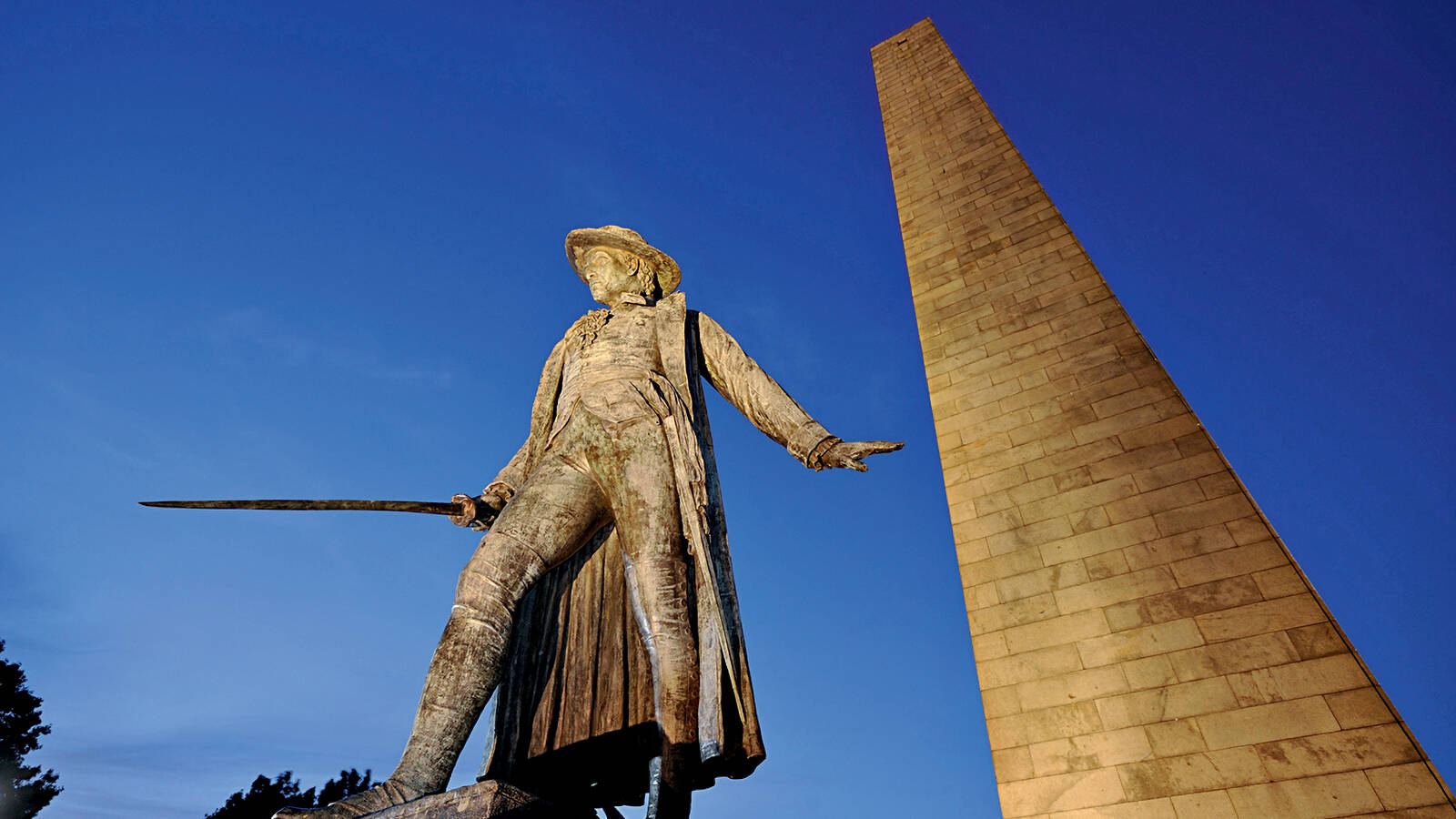
In 1975, for the American bicentennial, the U.S. government issued a postage stamp featuring Poor’s image (the same year, the Bunker Hill Monument, which was completed in 1842, became part of the National Park System), and in 2001, the National Park Service published a pamphlet celebrating Poor’s life and service.
FORCED INTO BATTLE?
Here’s what historians have pieced together about Poor’s life: Born into slavery in the 1740s, he was acquired as an infant by Lydia Abbott in Salem, Massachusetts (archival accounts suggest this could be how he got his name), and brought to Andover, where he grew up working on the farm of John and Rebecca Poor, whose son married Abbott’s daughter. In 1769, Poor purchased his freedom for 27 pounds, or roughly a working man’s annual wages. How he earned the sum is unknown, but he may have been paid for his labor performed for others, which was not uncommon in New England at the time.
Before enlisting, Poor married Nancy Parker, an African American and Native woman who had also recently secured her freedom through a lawsuit. In the New England Colonies, “freedom suits” were sometimes brought on the grounds that people whose mothers were born free could not be sold into slavery. Often, owners didn’t bother to contest the cases.
Edward L. Bell, an independent researcher who has studied Parker’s life extensively, explained that Poor and Parker may have pooled their resources and knowledge of such laws. “I think they strategically planned this freedom suit for her,” he said, “so that they could get married, and have kids who would have a legal declaration of contingent freedom.” Records show the couple had a son, Jonas.
Given the treatment of non-white people in the Colonies, which, in addition to enslavement, included the brutal removal of Indigenous people from their lands, it’s unclear why Poor — and more than 5,000 Black and Native American men — would enlist to fight the British in the first place. Hannigan’s research suggests the reasons varied, and for some, it was probably about making a living. “Most of the men are receiving money,” he said. “Some men are receiving cattle. You see bushels of grain.” In the case of some enslaved soldiers, service was tied to freedom, which also bears out in historical records. For others, though, there were no such guarantees; some colonists sent enslaved men to fight in their place and collected their pay.
As a freed man, Poor would have chosen to enlist, and it’s possible he was stirred by talk of patriotism and liberty in the Colonies. Even though he served honorably, there’s little evidence that his distinguished service improved his lot. The petition praising him was tabled by the legislature and never acted upon. Poor himself might not have known about it.
And as impressed as the officers who signed it might have been, Hannigan said, it’s probable their support of Poor was driven partly by self-interest. A couple of weeks after the Bunker Hill battle, George Washington assumed command of the Continental Army, and he promptly banned Black soldiers from enlisting. Concerned about meeting troop quotas, the Massachusetts officers may have held up Poor’s example in the hope of convincing Washington that soldiers of color were just as capable and dependable as any men in the field. “These white officers were not doing this because they believed in Black freedom, or even Black personhood,” Hannigan said. “They believed in recruiting numbers for their army.”
Washington reversed his decision, and ultimately Poor would go on to reenlist — serving three more years and fighting in some of the war’s most significant battles, including at Saratoga. He served until 1780, and later that year he was married a second time after having separated from Parker. By the end of his life, he had married twice more and fathered at least two children. He spent time in Providence, Rhode Island, before returning to Boston. Records show he was admitted to an almshouse in 1793, and in 1799, he was briefly jailed for “breach of peace.” Details about his life after the war are scant, but the road was probably not easy.
They picked Salem Poor for a reason. We don’t know what that reason is.
“Before the war, there had been a vibrant Black community in Boston,” Hannigan said. “But the British take over the city, and most people evacuate. I think it was just very difficult for people who were living more of that transient lifestyle to find themselves and get settled.”
In addition, despite their role in winning the country’s independence, veterans were not exactly celebrated after the war. “Many people, particularly in New England, had a pretty dim view of soldiers,” Hannigan explained. “There was an understanding that armies were tools of the tyrants.” Although disabled soldiers were granted some benefits just after the war, pensions wouldn’t be offered to all Continental Army veterans until 1818.

National Parks
You can read this and other stories about history, nature, culture, art, conservation, travel, science and more in National Parks magazine. Your tax-deductible membership donation of $25 or more entitles…
See more ›Poor died in 1802 and may be buried in Boston’s Copp’s Hill Burying Ground or in the Central Burying Ground. While his name wouldn’t be widely known for decades, the Revolution he fought in had awakened African Americans to new possibilities for dignity and equality under the law. In 1783, Quock Walker successfully sued for his freedom, and slavery in Massachusetts was declared unconstitutional, though the institution wouldn’t be abolished until the passing of the 13th Amendment to the U.S. Constitution in 1865. Other veterans of color, such as George Middleton, who led the Bucks of America (one of several Black militias active during the Revolutionary War period), would become activists for emancipation in the years to come, alongside Prince Hall and other Black abolitionists in Boston.
Hannigan said that although the attention paid to Poor’s life is understandable, his story is one among many. “It’s great that we know who he is,” he said, “but we should also remember that he’s one of several thousand Black men who served in the Revolution, all of whom had stories to tell.”
About the author
-
 Dorian Fox Contributor
Dorian Fox is a writer and freelance editor whose essays and articles have appeared in various literary journals and other publications. He lives in Boston and teaches creative writing courses through GrubStreet and Pioneer Valley Writers' Workshop. Find more about his work at dorianfox.com.
-
Press Release
Federal Court Blocks Border Barrier Construction at Big Bend National Park
Congress designated Big Bend National Park to protect our country’s natural wonders, and people come from all over the world to experience its star-filled skies and striking mountain ranges. Big…
-
Press Release
Swing and a Miss: Grand Teton Safe at Home After MLB Withdraws Proposal
"The bases were loaded with opposition, and this news is a grand slam for Teton county communities and the enduring legacy of Grand Teton National Park" -- NPCA Grand Teton…
-
Press Release
NPCA and Partners Appeal State of Alaska’s Decision to Grant an Easement for the Ambler Mining Road
“...the proposed 211-mile Ambler Road would be a disaster for Gates of the Arctic National Preserve and the Western Arctic Caribou herd that crosses it" - Naawéiyaa Tagaban, NPCA Alaska…