Stretching across Chicago’s Southeast Side and northwest Indiana, the Calumet region tells a powerful national story—one of resilience, innovation, and of the diverse communities who have contributed to our country. For many years, advocates have called for the establishment of a national heritage area to tell this story, connecting and building upon those told at Pullman National Historical Park and Indiana Dunes National Park. Recognizing the Calumet region as a national heritage area would honor its vital contributions to our nation’s history and ensure the preservation and celebration of the natural and cultural resources found here.
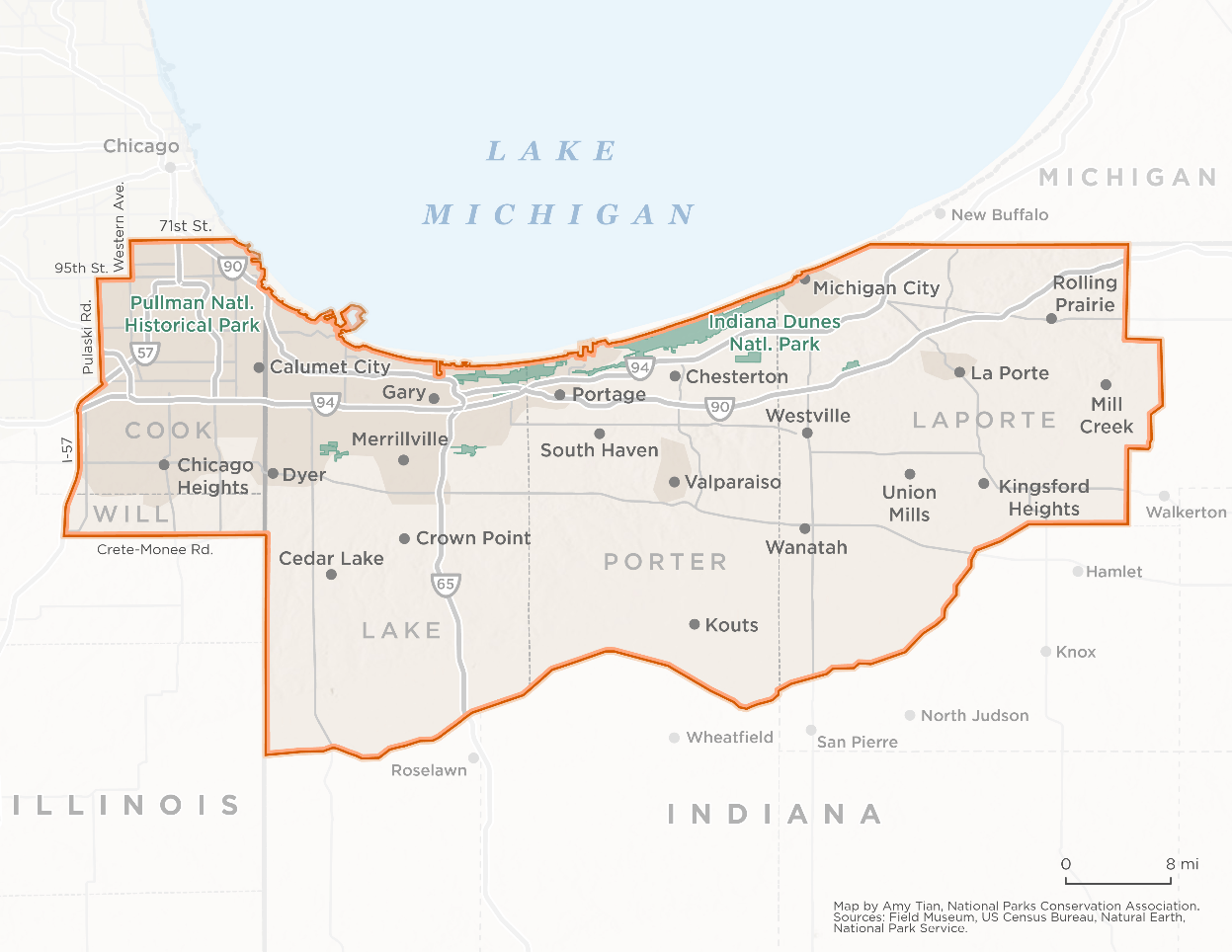
The proposed Calumet National Heritage Area. Map by Amy Tian.
Nestled along the southern shore of Lake Michigan, the Calumet region hosts a vibrant mosaic of diverse ecosystems, winding waterways, and resilient communities sharing a storied industrial legacy. Here, fascinating natural and American history intertwine in a setting influenced by both ecological wonder and human innovation. The region offers a striking blend of natural areas and manmade structures, from the globally rare black oak savannas and wetlands of Indiana Dunes National Park to planned worker communities like Marktown, and architectural treasures like the Greenstone Church in Chicago’s Pullman National Historical Park. In the Calumet, forest preserves and restored prairies are tucked between railroad tracks and steel mills – the same mills that produced Chicago’s skyscrapers and equipment and vehicles that supported the Allies’ victory in the Second World War. The Calumet is a region that is significant not despite its contrasts, but because those contrasts coexist.
The Proposed Calumet National Heritage Area
Special Thanks
The Calumet National Heritage Area Act (PDF) presents an opportunity for this region’s stories to be told on the national stage. This legislation – introduced by U.S. Senator Todd Young and Representative Robin Kelly – would establish the Calumet region as the latest addition to the National Heritage Area System. This system was formalized by Congress in 2022 to help protect and connect diverse American history in communities across the country.
National heritage areas operate as private-public partnerships in which the National Park Service provides technical expertise and a small amount of federal funding in support of local nonprofits that manage the areas’ operations, programs, and interpretation. These nonprofits are also tasked with raising dollar-for-dollar matching funds for the National Park Service’s investment. Historically, nonprofits have far exceeded this, raising an average of $5.50 for every federal dollar received.
Advocating for the Calumet National Heritage Area
Establishing the Calumet National Heritage Area will help broaden the reach of the region’s national parks and offer a more comprehensive look at conservation and American history for the millions of visitors that travel to these parks each year. NPCA will continue to advocate for the Calumet National Heritage Area Act, honoring an industrious, culturally diverse, and ever-changing region of outstanding significance to our nation’s history.
Thank you to NPCA’s Cultural Engagement Intern, Kyah White, for her contributions to this webpage.
For More Information
-
General
-
- NPCA Region:
- Midwest
-
-
Issues
-
Press Release
Atrocious Reported Changes to the ESA Could Threaten Extinction to Park Wildlife, Wild Nature
"This memo appears to suggest that it’s no longer the purpose of the ESA to ensure animals such as grizzly bears, North Atlantic right whales, or Florida panthers are protected"…
-
Press Release
First Mining Claims Filed in Lands Cut from Bears Ears National Monument
"National park units and their surrounding landscapes are no place for energy development, but outdated laws elevate mining above all other uses on these lands. We will continue to fight…
-
Press Release
Groups File Injunction to Stop Development at West Potomac Park
“West Potomac Park is treasured green space and we will not stand for the unlawful destruction of public lands that belong to all of us."