Fall 2026
It’s Better to Hike in Wet Socks
Braving swamp, mud and heat on a marathon sprint through Big Cypress National Preserve.
“The mud will suck the life out of you.”
“Here we’re closer to the equator, so the sun cooks you faster.”
“Don’t step on the spicy noodles” — otherwise known as snakes.
These were some of the replies I received from members of the Florida Trail Hikers Facebook group when I asked whether it was possible to hike, in a little over a day, the 30-some-mile section of the Florida National Scenic Trail that cuts through Big Cypress National Preserve.
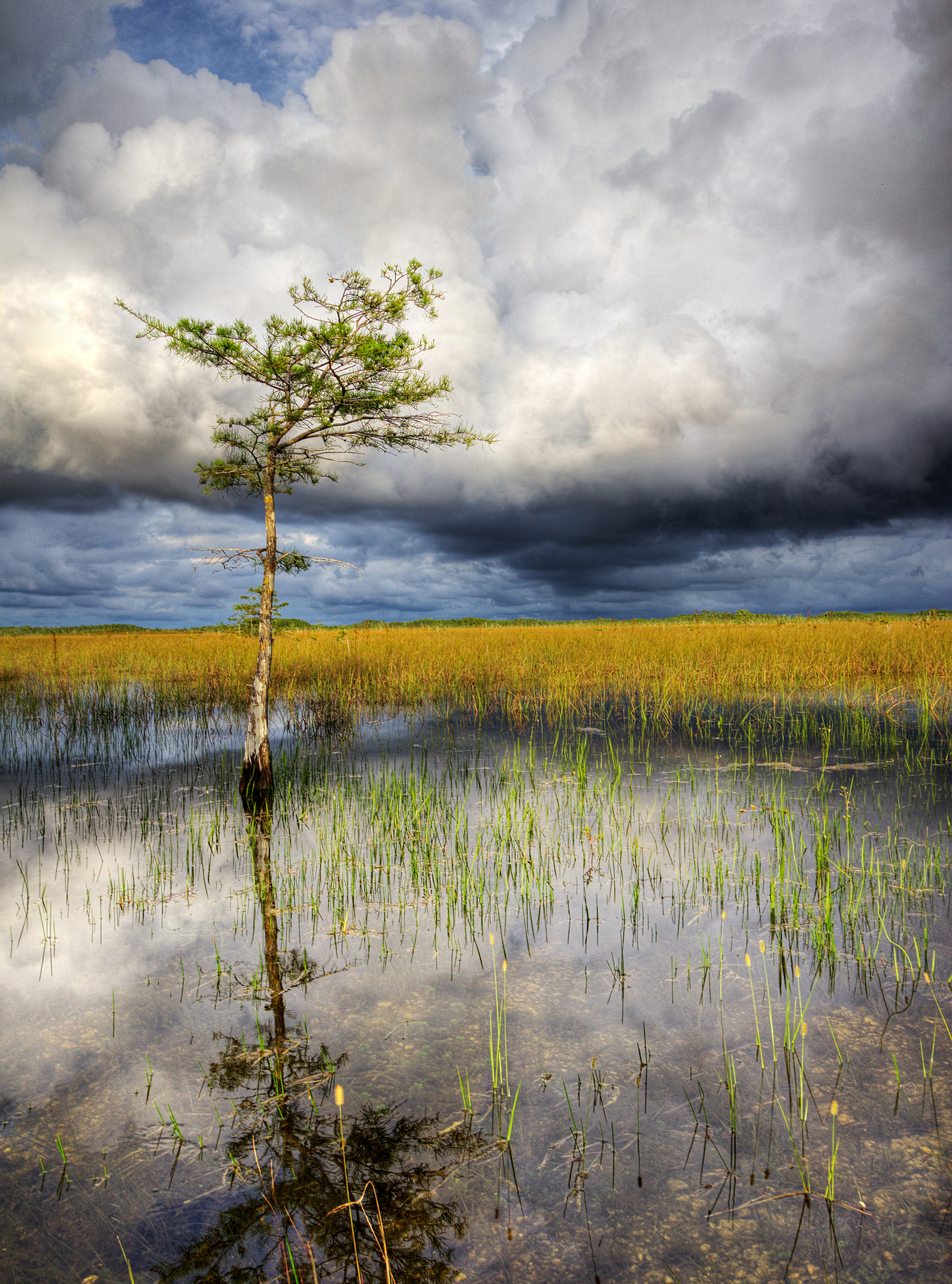
Some enthusiasts believe the best time to hike in the preserve is the winter, when the water is high. “It’s one of the most beautiful things on Earth,” said Eric Emery, who has hiked the entire Florida National Scenic Trail seven times.
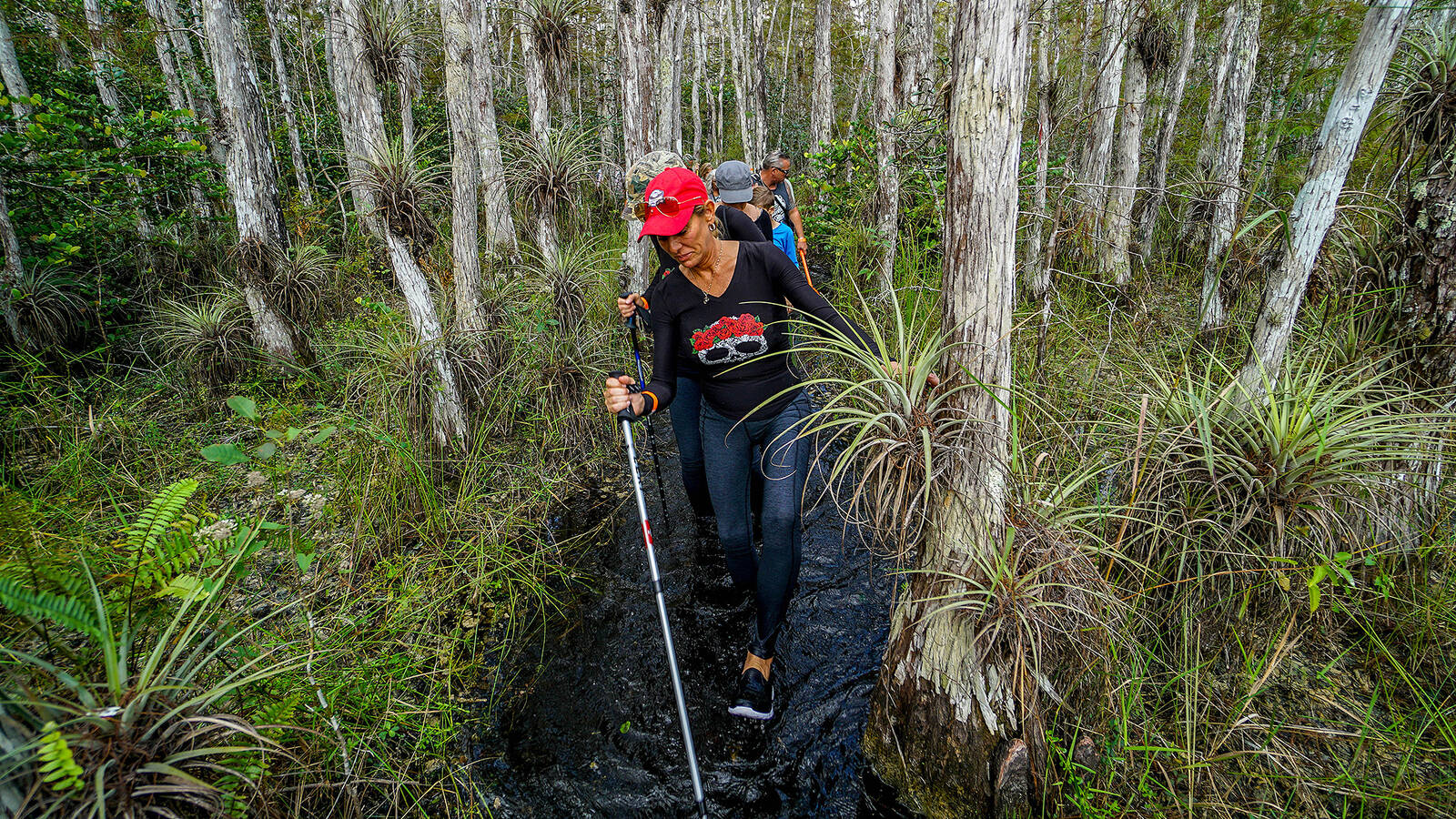
©STEPHEN SHELLEY PHOTOGRAPHYIn short: The hiking community answered my query with a resounding “no.” I learned that in wet seasons, the route is known as an “underwater trail.” Hikers have no choice but to baptize their feet in the swamp’s waters and mudflats, and the legendary mud can slow them down from, say, 3 mph to 0.3 mph. Sometimes, almost the entire Big Cypress section is flooded. One Florida Trail enthusiast told me that one year the land was so sodden he had to collect and pile dead palm fronds just to raise his tent above the water. Another year, campers had to sleep on picnic tables. One trail expert advised me to set aside “4 nights/5 days to be on the safer side to avoid exhaustion.”
I was not looking for an Ironman-style challenge, but I had only about 30 hours between a work event in Fort Lauderdale and a flight out. And I really wanted to see nearby Big Cypress, a vast lowland wilderness of cypress swamp, marl prairie, pinelands, hardwood hammocks and mangrove forest.
Most visitors who go to the preserve stick to the visitor centers or short boardwalks or nature trails along the highway, and off-road vehicles are popular. “Not a whole lot of people want to venture into a swamp,” said Lisa Andrews, outreach and education coordinator at the park, who kindly offered to pick me up at the I-75 rest area, on the far side of the preserve, should I attempt the hike. “They think it’s going to be nasty, smelly, slimy, dirty.” Plus, Big Cypress is inhabited by wildlife that is unfamiliar to me and therefore extra scary: Florida panthers, cottonmouths, alligators and invasive Burmese pythons, some nearly 20 feet long and capable of swallowing deer and even alligators.
But for those who love the park, as Andrews does, or want to explore the backcountry on foot, as I did, the Florida Trail is perhaps the best option. One of the country’s 11 national scenic trails, it begins at Big Cypress’ Oasis Visitor Center and runs roughly 1,500 miles north and west to Gulf Islands National Seashore near Pensacola.
As it had quickly become clear, under normal conditions — even in the dry season — it would be all but impossible to cover the southernmost 30 miles of the trail in the short window I had, but there was a loophole of sorts: Big Cypress was in the midst of a serious drought. That was not good news for the swamp or its creatures, which depend on water, but it meant the trail would be uncharacteristically dry. As a former backcountry ranger in Alaska national parks and thru-hiker who had crossed North America’s Great Plains, I knew I could do fast miles on those stretches of dry ground. On the other hand, a waterless swamp meant I’d have to haul my own drinking water — 12 liters under a scorching sun.
As I pondered the possibilities, I could see that the thought of the hike stirred in me a familiar mix of excitement and fear — usually a reliable sign that I was about to do something at once foolish and worthwhile. I settled the matter with a bullheaded and perhaps delusional “why not?” Some weeks later, at the end of April, I began my hike before dawn in a state of mild trepidation.

When Your Toddler Meets a Crocodile
How wise is it to bring a kid on a canoe trip through the watery wilds of the Everglades?
See more ›Walking into a swamp for the first time in pitch blackness at 4:45 a.m. may not be the ideal way to introduce yourself to a strange landscape. My headlamp led the way, blasting a white spotlight down a narrow tunnel of leaves, trunks and palmetto fronds. I was alert to every rustle at first, though the only actual threats that materialized were throngs of mosquitoes that I found both unusually evasive and impressively vicious.
Every few feet, I walked face-first into a spiderweb, suggesting either that the trail had gone unvisited for some time or that the spiders here were particularly assiduous. I grew accustomed to pinching the webs off my face as if removing a mask and later, took to swatting at likely strands with my trekking pole as if it were a machete taking down invisible vines.
As the first glimmer of daylight seeped into the trees, the forest awoke with birdsong, and with the sun lighting my way, my worries began to dissipate. I stopped constantly thinking I was about to step on a snake — or alligator. (These fears were not exactly unjustified: Andrews had told me a story about an alligator that once exploded from the water after a professor and his students accidentally stepped on its tail.)
The enclosed green tunnel I had entered widened, revealing an open savanna. Around me was a true mosaic: grassy knee-high prairie; stands of charred but living cabbage palms, their trunks blackened by fire (likely from a controlled burn); breezy pine forests; and, despite the drought, an unending palette of varied and vibrant greens.
In the distance was the strangest landform of all: a cypress dome, which looks like a small hill on the otherwise flat expanse, but actually signals a depression. The cypress trees grow tallest in the center of the domes, where nutrients are dense and water often pools, and grow shorter along the edges, leading to the rounded shape. In some domes, the pondlike pools are too deep in the middle for cypress to take root, creating a watery hole in the doughnut that persists late into the dry season and draws a range of wildlife: wading birds, frogs, fish, alligators, the whole desperate congregation. As Andrews put it, the gators have “a little fast-food restaurant.”
A few hours in, I arrived at a picnic table and paused, taking stock. I stood on it to gain a little elevation, and my 3-foot rise brought my altitude from 6 feet above sea level to 9 feet — a whopping 50% increase. (The preserve’s highest ground reaches only about 18 feet above sea level.) In Big Cypress, topography is measured less in feet than inches, and each inch can create a different ecosystem. A slight rise means pine, while a slight dip means cypress. A deeper hollow becomes a dome or gator hole.
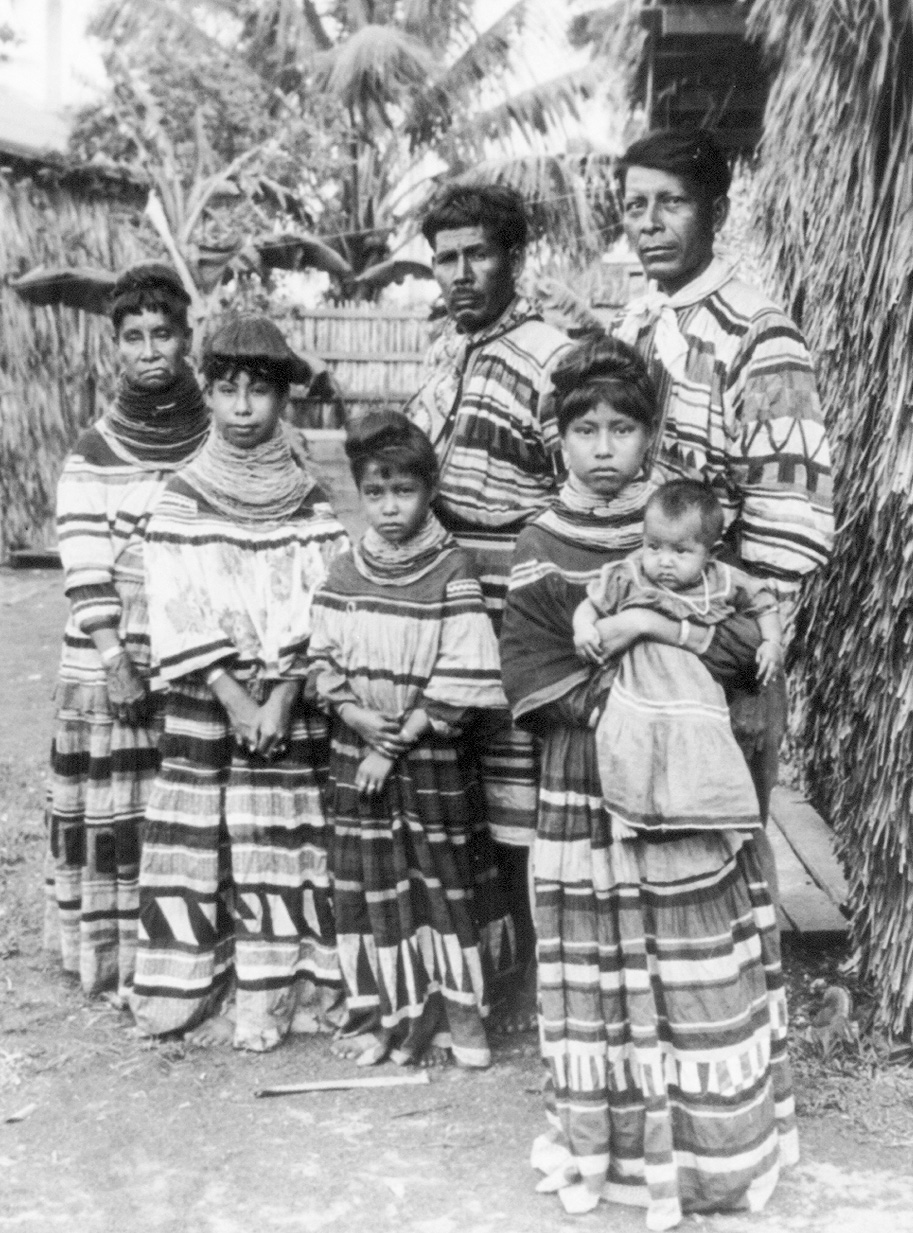
Seminoles in 1926. The preserve, which is part of the ancestral land of the Miccosukee and Seminole peoples, is currently home to several active Indigenous villages and many cultural sites.
LIBRARY OF CONGRESSTo me, the landscape appeared perfectly still, but when there’s water, it is always moving: rainwater sliding across the limestone in a wide, shallow, seemingly motionless sheet. That slow movement has shaped not only the ecology of Big Cypress but also its human history.
The national preserve was established half a century ago, but people have been part of this watery ecosystem for thousands of years. What is now Big Cypress is part of the ancestral homeland of the Miccosukee and Seminole peoples.
During the first half of the 19th century, the Indigenous people of Florida fought U.S. efforts to remove them in a series of conflicts now known as the Seminole Wars. As the fighting ground on, the Tribes took refuge deeper in the Everglades. Then in the 1850s, under pressure from the U.S. military, thousands were forced from the Big Cypress region to Indian Territory west of the Mississippi River. A smaller number remained in South Florida; their descendants continue to maintain a connection to the preserve, which is currently home to several active traditional villages, many cultural sites, and numerous hunting, gathering, ceremonial and burial grounds.
The water itself has its own history of disruption. Throughout the 20th century, canals, roads and levees interfered with the sheet flow that once moved generally southwest through this corner of Florida.
NPCA AT WORK
Then, in the 1960s, plans were unveiled for what would have been one of the world’s largest jetports in the heart of the Greater Everglades, with six runways, supersonic aircraft, and new roads and development that would have pushed into the swamp. Opposition to the airport, and to the growth expected to follow it, brought together an unlikely coalition of hunters, fishermen, environmentalists, Seminoles and Miccosukees.
They managed to stop the project, and in 1974, Big Cypress became America’s first national preserve (tied with Big Thicket in Texas, established on the same day). The designation protected an area nearly the size of Rhode Island while allowing many older uses to continue and explicitly safeguarding Miccosukee and Seminole rights to stay in their villages and use the land and water in their customary ways. “They had to call us something different,” Andrews said, “so they called us a preserve instead of a park.”
Those compromises, while essential to creating the preserve, did not permanently settle the many arguments over Big Cypress, which has since expanded to 729,000 acres. To this day, the preserve remains contested ground, with disputes over oil and gas activity, off-road vehicle use, Tribal access, wilderness designation, and how best to restore the water’s old, slow movement across the land.
Out on the trail, with no one else in sight, that long history and those ongoing battles were mostly invisible to me. What I walked through felt like wilderness, and because I was moving so fast, I could only partially take it in. Ari Hirschman, a moderator of the Florida Trail Hikers group who has hiked Big Cypress several times, told me he’s the sort of hiker who, like me, enjoys pushing himself to go harder and faster. But once, while helping a slower hiker through a water-logged section, he was forced to bring his pace down to hers.
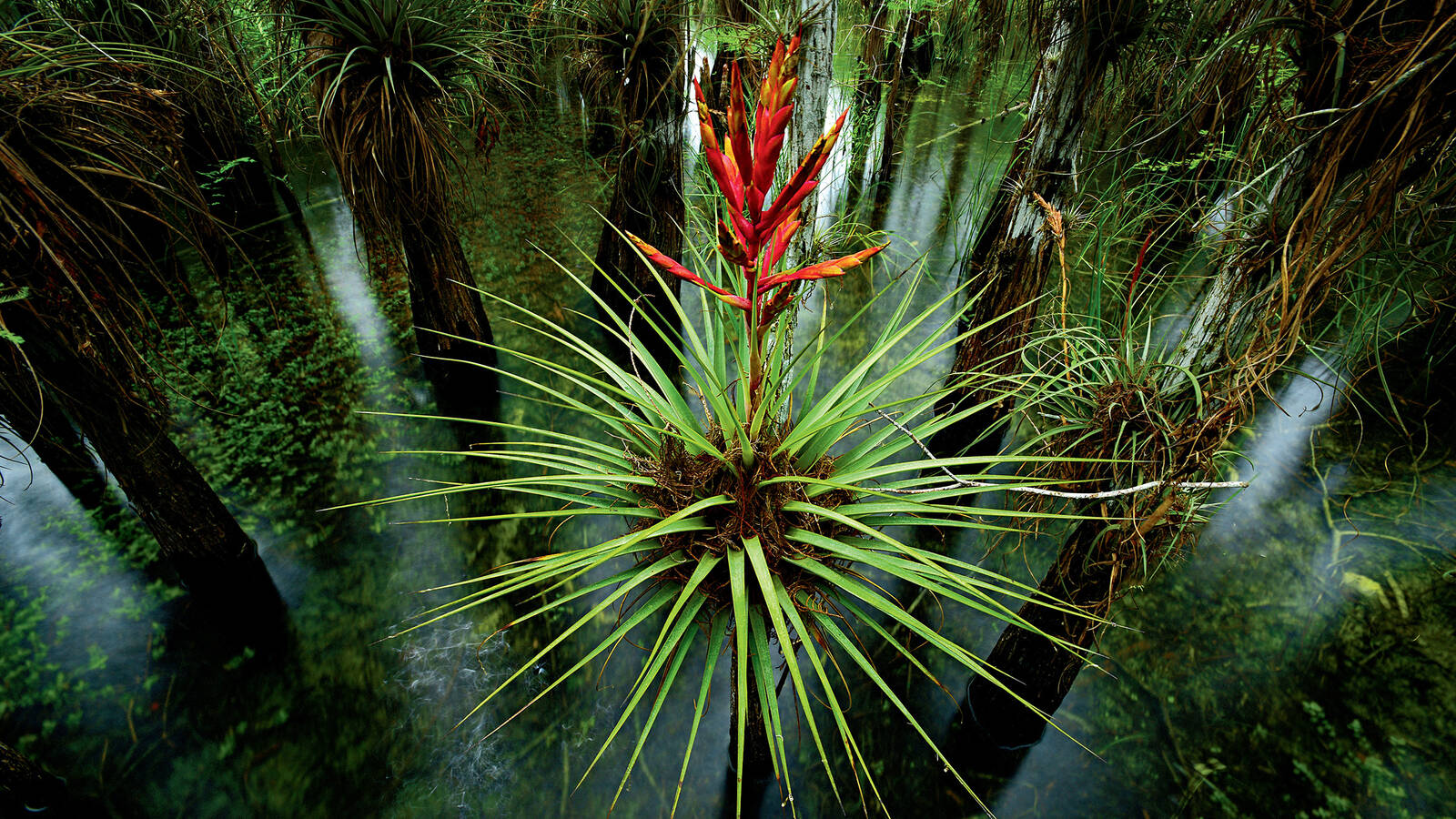
“The fact that this lady was going so slow,” Hirschmann told me, “just allowed me to really look and see everything and enjoy the hike and the path.” At that pace, he noticed what speed can blur: tiny carnivorous plants floating in the swamp water; the reddish hue of bromeliads, air plants that grow harmlessly in trees; and the way the light made everything look Technicolor.
His words were on my mind as I powered through, and I tried, even as I hurried, to take note of the smaller things: The land smelled citrusy, like a warm mug of lemongrass tea, and in some corner of the soundscape a barred owl hooted, a pileated woodpecker thumped, and palm fronds swished in the wind. Overhead, three turkey vultures soared.
By 10 a.m., I’d already walked 9 miles. I was pleasantly surprised to have made such good time, but I still had more than 20 miles to go, a hot late-April afternoon ahead of me and a pack heavy with water that pinched my shoulders. I had to carefully calibrate my pace. If I lingered too long in the shade, I would pay for it later. If I pushed too hard, I might pay for that, too. Keep going, but not too fast. And not too slow. Take breaks, but not too many.
Then, at last, I reached a stretch where the trail dipped into shallow water. Most hikers obsess over keeping their feet dry. But during my time in Alaska, I had learned that in wet country the better strategy is not necessarily to avoid wet feet, but to manage them: Wear shoes that drain, use thin socks, air your feet when you can and put on dry socks at night. In seven summers in Alaska, despite consistently having wet feet on hikes, I don’t recall ever getting a blister. On a hot, dry Montana hike last summer, I had about five within the first hour.
Eric Emery, a retired Navy veteran from central Florida who has hiked the entire Florida Trail seven times and the Big Cypress section 11 times, had learned the same lesson. He’d seen hikers approach flooded stretches as if playing “the floor is lava,” hopping from root to rock to grass clump in a doomed effort to preserve dry feet. “You waste a lot of time doing that,” he told me. “Once your feet are wet, they’re wet. So I just hike through the water.”
The trail’s real pest, Emery told me, was the “soul-sucking” mud: “It gets like walking through knee-deep wet cement.” In 2017, he said, several hikers dislocated knees while trying to pull their legs out of the mud, and one hiker pulled all the muscles along one side of his ribs in an attempt to yank himself loose by hoisting himself up with a cypress tree.
The best conditions, Emery told me, are watery, not dry. He prefers to hike in January or February, when the temperatures are mild, the rainy season is over, and the swamp water is knee-to-crotch high. “It’s just you and the swamp water,” he said. “To me, it’s one of the most beautiful things on Earth to see.”
My own feet were submerged for only about a mile in all, but each time a new watery section appeared, I looked forward to sinking ankle-deep into it. I’d heard about hikers seeing turtles underfoot and fish swimming ahead of them. The swamp water wasn’t deep enough for that, but I at least could watch the tadpoles and water bugs zigzag in front of me like NFL kick returners headed for the end zone. The water wasn’t slimy or algae-infused as I’d expected, but clear and cool enough to ease whatever swelling had begun inside my shoes. I’d forgotten to pack an extra pair of socks, but I soon made peace with the ones I had, irreversibly soggy though they were. Wet feet came to seem less like a failure of preparation than the price of admission. Big Cypress was not a place you kept out, but one you let in.
In the early afternoon, in one forest thicket, the usual scent of citrus was replaced by something musky. I called out, “Hey bear!” and plodded on, now under a merciless sun, my shoulders aching.

A Thousand Miles in a Hundred Days
Photographer Carlton Ward, Jr., leads a team of explorers on an ambitious, self-propelled journey through the Everglades and beyond.
See more ›In some sections, the ground changed to limestone caprock, pocked with solution holes that your whole leg could fall into. The surface felt like floor tiles at best and railway ties at worst. The hikers had warned me about these ankle-breakers, and Andrews had told me that if I could see a cross-section of the limestone below me, it would look like Swiss cheese. I had to shorten my stride and choose each footfall carefully.
I found a few bear prints in the mud next to what looked like a bare human footprint. Were people really hiking barefoot out here? Given what I’d heard about boot-stealing mud and the softness of the ground, it occurred to me that this might not be the worst place to go barefoot.
By midafternoon, I made it to Oak Hill Camp, one of the designated campsites along this section of the Florida Trail, where I sat in the shade beneath towering oaks. After a minute of stillness, the woods came alive. I heard steps rustling in the dry leaves and wondered what large mammal might be approaching, only to realize it was a bug. Skinks and anoles added to the commotion, skittering across open ground and up tree trunks, sometimes popping their heads out from behind the bark to eye me curiously.
I wanted to stay longer, but I had to watch the clock. By 4:30 p.m., the sun had shifted, and I no longer had the shade of the oaks. The shallow water felt uncomfortably warm. Twice I wandered off the trail — well marked with dark orange blazes — and wondered whether these were ordinary blunders or heat-induced ones. As the temperature rose to the 90s, it felt like my IQ was moving in the opposite direction.
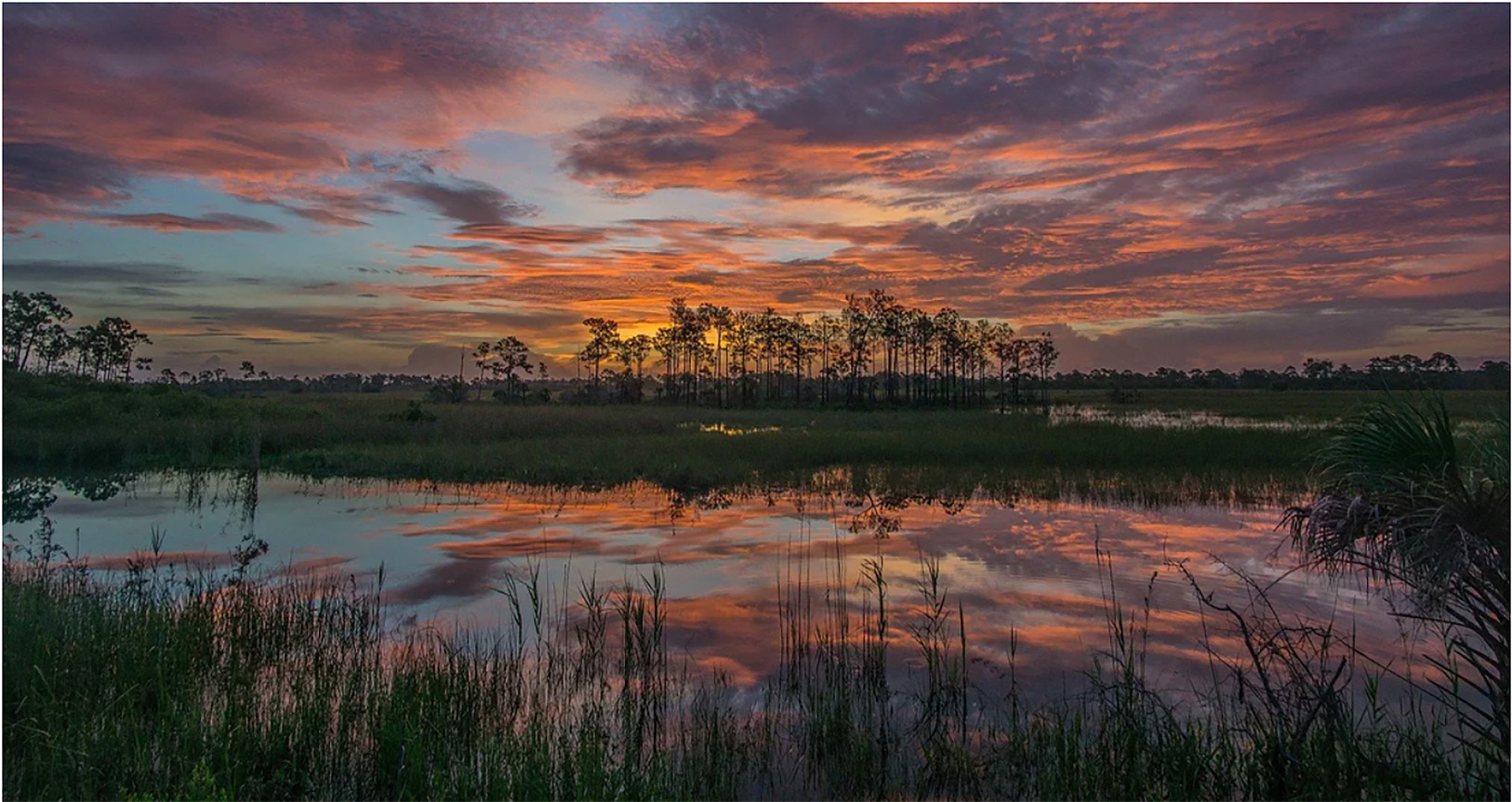
“A walk through a wilderness has a way of making you feel both proud and humbled,” writes Ilgunas.
NPS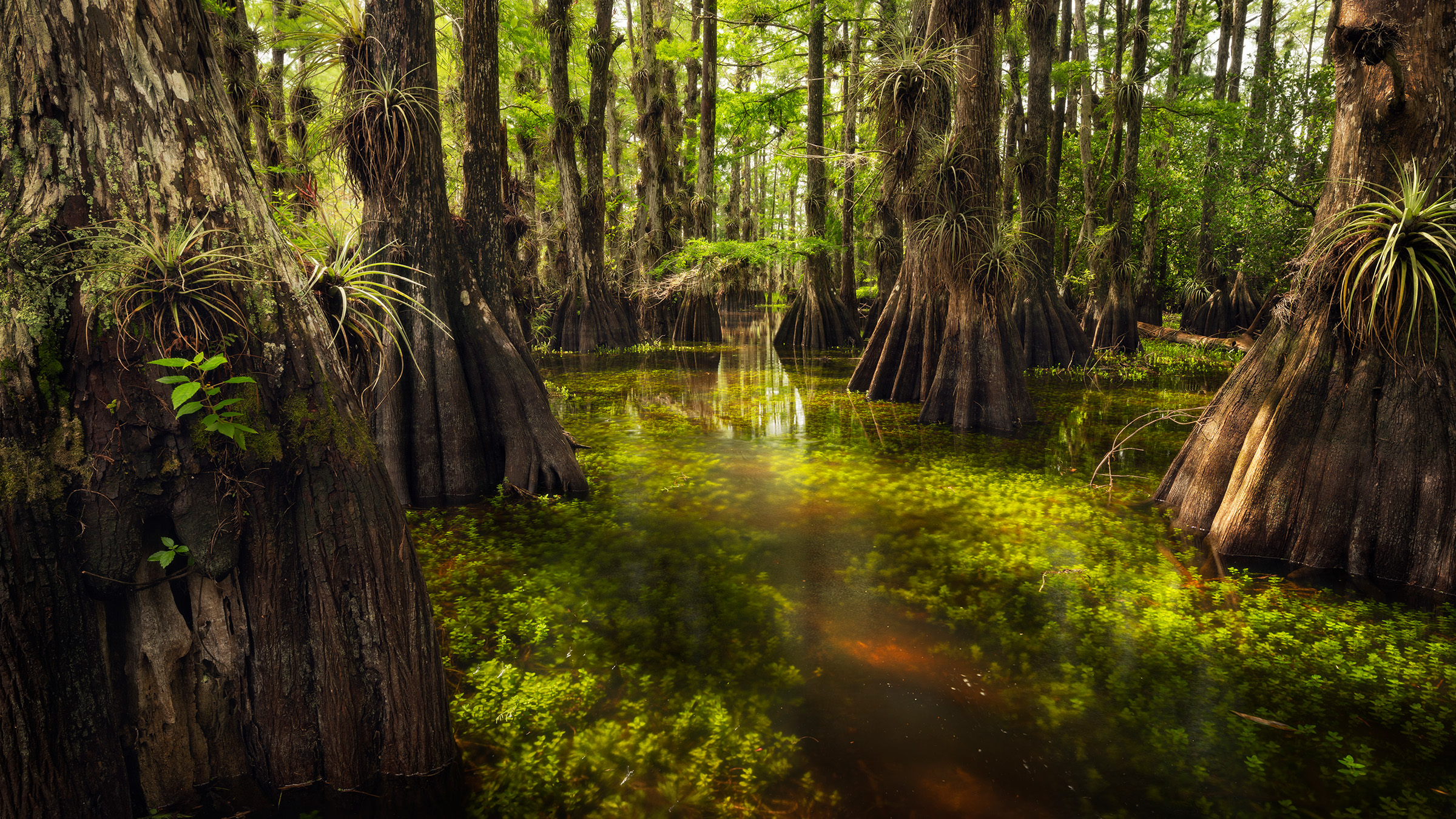
In some cypress domes, the pondlike pools in the middle persist late into the dry season, drawing a range of wildlife.
©PAUL MARCELLINIMost hikers wear fast-drying synthetic clothes, but my cotton shirt, usually a backpacking no-no, held sweat against my body, cooling me down. Heat is a serious threat here, and hikers are sometimes evacuated from this trail — either because it’s too hot or too exhausting — and at least one has died from heatstroke.
I crept beneath a small bush to collect myself in the dappled shade. Civilization had not entirely abandoned me: I had a couple of bars of 5G, enough to watch highlights from the Sabres-Bruins game from the previous night. I made myself a cheese burrito and slugged a whole liter from my generous water supply. Then I slogged on, entering a state similar to a runner’s high, in that I felt like I could keep moving forever, except it wasn’t so much a “high” as the grim acceptance of a day spent at the speed of an endless trudge.
At 7:30 p.m., when I reached Ivy Camp — just around 4 miles from my I-75 endpoint — I took a moment to admire my progress while noting, with faint disbelief, that the day had an actual end. I could have reached the interstate if I’d pushed on for another couple of hours, but my pickup wasn’t until morning, and the swamp no longer felt as menacingly exotic as it had before dawn. It’s remarkable how a single day in a strange place can make it feel almost familiar. I set up my tent and used a sweaty bag of shredded Gouda as a pillow. The ground was warm and soft enough that I did not regret leaving my sleeping pad behind. I slept effortlessly.
At first light, I rolled out of my one-person tarp tent. My feet went back into my wet socks, then into my wet shoes, and I started north. In the last miles, the blaring interstate traffic, however unpleasant to the ear, became a welcome sign that I was close to my destination — and that I’d probably catch my flight.

National Parks
You can read this and other stories about history, nature, culture, art, conservation, travel, science and more in National Parks magazine. Your tax-deductible membership donation of $25 or more entitles…
See more ›I reached the rest area well before Andrews expected me. I called her, then lay on a bench with my feet drying in the sun. My pack, sitting on the ground next to me, was fuller than ideal: I’d packed 4 liters too much of water and had ended up carrying an unnecessary 9 extra pounds for the whole hike.
When Andrews arrived, she looked at me with some amusement.
“It looks like you set a record,” she said.
I didn’t feel like a record-setter. A walk through a wilderness has a way of making you feel both proud and humbled. I’d been scared, sunbaked, heat-addled, thoroughly exhausted, and I was unreasonably filthy for just one day out. I was merely happy to have done it, leaving with a visceral gratitude for the luck of having a life that lets me dip in and out of wildernesses, whether familiar or foreign.
I’d walked through a land where bugs could sound as loud as bears, where cypress domes looked like hills, and where terrain that appears flat and forgettable from the highway is alive with small wonders, whether above or in water. Next time, I told myself, I’ll do it underwater. I’ll do it slow. But even in a hurry, I had taken some of the swamp with me: in my memory, in the heat still coming off my skin and, of course, in my shoes.
About the author
-
 Ken Ilgunas Contributor
Ken Ilgunas is the author of “Walden on Wheels" and “Trespassing Across America,” as well as the host of the "Out of the Wild" podcast and Substack.
-
Press Release
Interior Turns Alaska Parks Into Game Farms with Outrageous Hunting Rule
“It’s as outrageous as it is disheartening to again see the Interior Department go along with the state of Alaska’s effort to turn national parklands into de facto game farms."
-
Press Release
NPCA Celebrates Staff Expert's New Book on Blackwell School National Historic Site
A groundbreaking new book co-authored by NPCA's Cristobal Lopez tells the history of Blackwell School National Historic Site, highlighting the experiences of the Mexican American students who attended the segregated…
-
Press Release
Trump Administration Continues to Unlawfully Bulldoze National Mall Parks
“This egregious destruction continues to show how the Trump administration operates as if laws don’t apply. They continue to move forward, disregarding the will of the American people for which…


![[FALL 2026] Big Cypress Spoonbills](https://npca.s3.amazonaws.com/images/30249/ffe60235-c17a-4c28-8bb9-76d2b96ff187-original.jpg?1787594738)
![[Fall 2026] Big Cypress Panther](https://npca.s3.amazonaws.com/images/30250/51513dd0-8cd0-4fdc-b45d-4ce56e6d9059-original.jpg?1787594720)
![[Fall 2026] Big Cypress Alligator](https://npca.s3.amazonaws.com/images/30251/a6830d8f-53ef-4b1c-bd3e-99cf484207fc-original.jpg?1787594893)