Summer 2026
Claiming Liberty
Ona Judge, an enslaved servant in the home of George and Martha Washington, escaped from the president’s house and eluded every attempt to apprehend her. Now the administration is trying to remove exhibits that tell her story.
By the spring of 1796, Ona Judge had been Martha Washington’s personal maid for around a decade, since she was about 10 years old, and had lived in the president’s residence — first in New York, then in Philadelphia — for six years. During that time, she had served alongside eight other enslaved people brought from Mount Vernon, where Judge was born, and where the Washingtons would eventually hold more than 300 individuals in bondage.

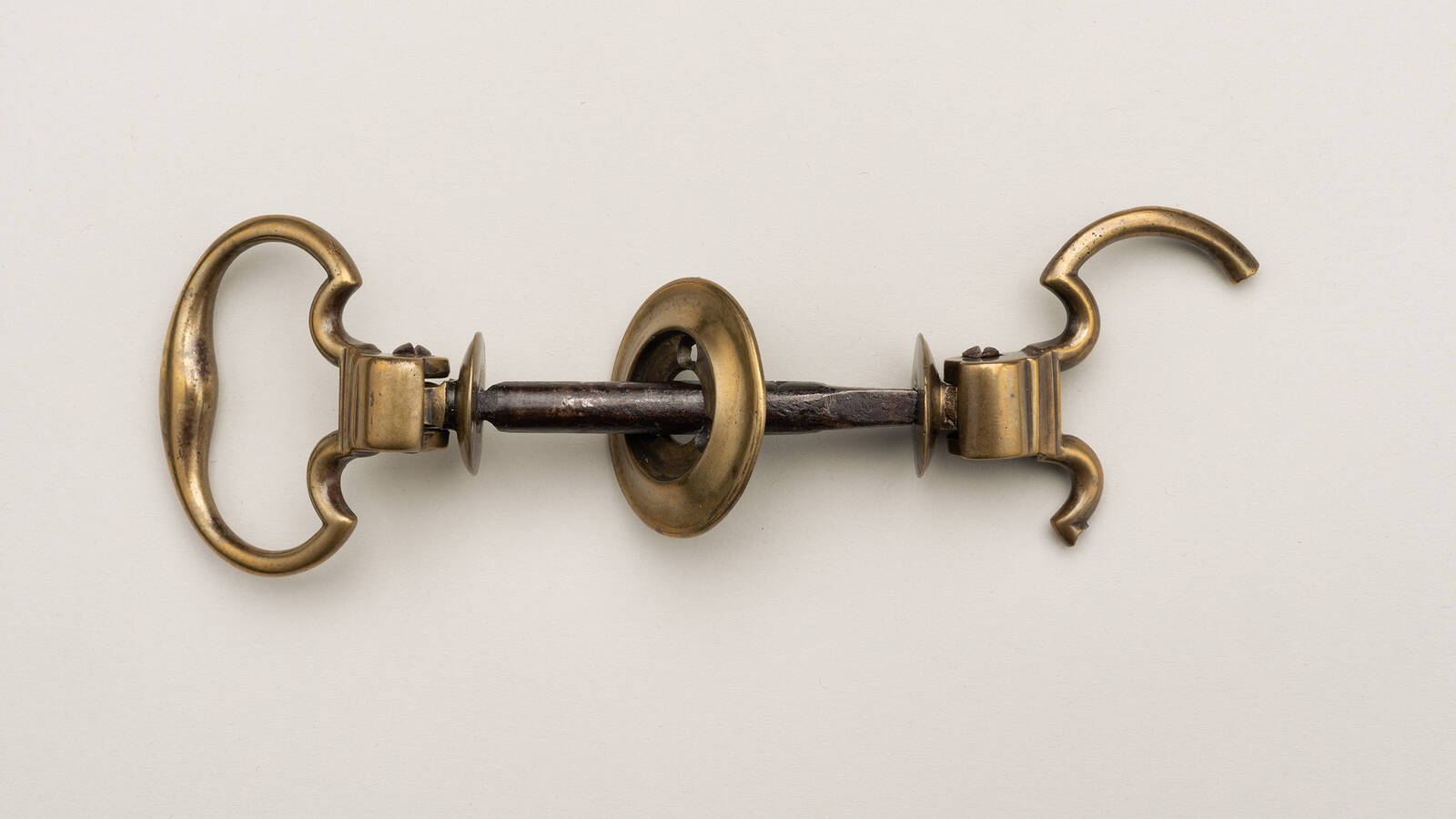
This silhouette meant to represent Judge is based on the information available about her appearance and duties.
©SALLY WERN COMPORTAs Washington neared the end of his two-term presidency, Judge knew the family planned to return to private life in Virginia, taking their enslaved staff with them. Also, she had learned she was to be given to the Washingtons’ notoriously short-tempered granddaughter, Elizabeth Parke Custis Law, as a wedding present.
But Judge had different plans. On May 21, she packed her clothes. Then, while the Washingtons had dinner, she slipped out of the president’s house — now a site in Independence National Historical Park — and into the Philadelphia evening. At the docks, she was aided by friends, likely members of the city’s free Black community, who had quietly secured passage for her on the Nancy, a ship bound for Portsmouth, New Hampshire, where abolitionist sentiment was strong.
It was the beginning of a life of liberty, but according to the law, Judge was a fugitive. In 1793, Washington himself had signed the first Fugitive Slave Act, which gave slaveholders permission to pursue runaway slaves across state lines, even in Northern states, some of which had by that time ruled slavery illegal or instituted gradual abolition laws.
Three days after Judge’s disappearance, an ad was placed in The Philadelphia Gazette & Universal Daily Advertiser by Washington’s steward. “Absconded from the household of the President of the United States, ONEY JUDGE,” it read, using her nickname, and described her as “a light Mulatto girl, much freckled, with very black eyes” and “many changes of good clothes.” The ad offered a $10 reward for her return. Thus began a yearslong effort to capture Judge, which she would elude — by her own wit and resolve, and with the help of allies — at every stage.
At the site where the president’s house once stood (the original residence was torn down in 1832), the names of “Oney” and eight others — including Austin, Judge’s half-brother, and the Washingtons’ chef Hercules — are inscribed on a wall. On the sidewalk, impressions of footprints are a tribute to Judge’s flight to freedom. Until recently, 34 panels also focused on “Freedom and Slavery in the Making of a New Nation” for visitors and passersby. The exhibit was completed in 2010 after a campaign by the Avenging the Ancestors Coalition.
Here’s this woman, she doesn’t have a lot of power, and she’s outsmarting the most powerful man in the country.
In January, however, the panels, which included information about Judge, were removed by park staff in response to an executive order by the Trump administration that sought to restore “truth and sanity to American history,” prompting an outcry from people across the country. The city sued, and in February, more than a dozen panels were reinstalled on a judge’s orders, though the rest remain in storage while the case is ongoing, and proposed new exhibits sanitizing Washington’s relationship to slavery have been posted on the park’s website. At other park sites, materials related to slavery, civil rights history, 19th century labor conditions and a white explorer’s participation in a massacre of Native Americans have also been removed or revised. (In February, NPCA and several partners represented by Democracy Forward filed a separate lawsuit in federal court to halt the administration’s efforts to erase history and censor science in all national park sites.)
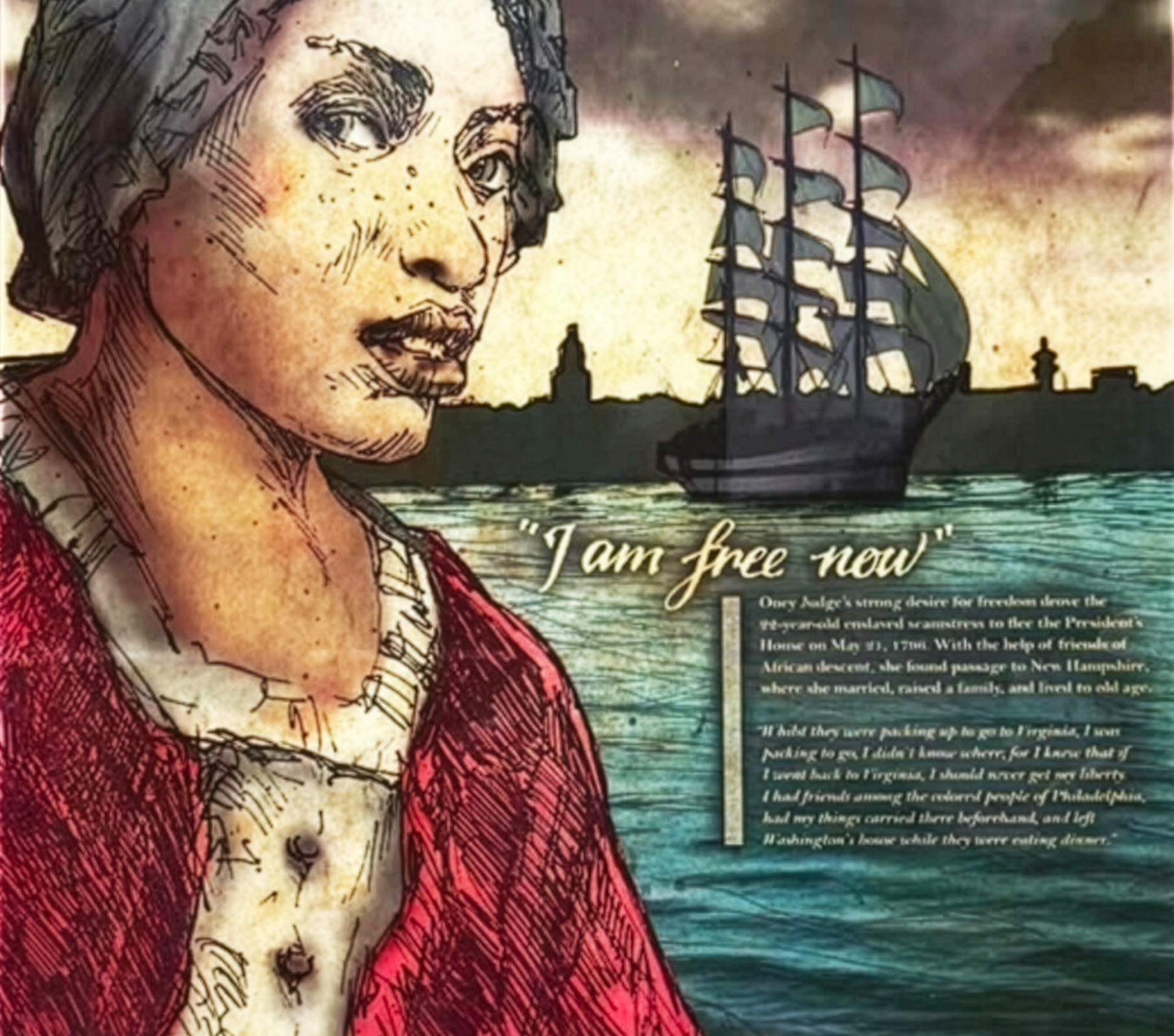
A sign about Ona Judge at Independence National Historical Park’s President’s House that was removed in January following an executive order from the administration. COURTESY OF DEANA TRAVETTI
Raina Yancey, a lawyer who also leads Black history walking tours in Philadelphia and is seeking to intervene as a plaintiff in the city’s lawsuit, said the panels’ removal was “a slap in the face to the activists who had that site built up and dedicated to the nine enslaved individuals.” Yancey’s mother was a part-time ranger at Independence, and she grew up running around the park. She said she didn’t learn about Judge until years later, but her story and the park exhibit have become integral to the tours she leads. “It must have been absolutely terrifying for her to take that journey,” she said, “so I just love her bravery.”
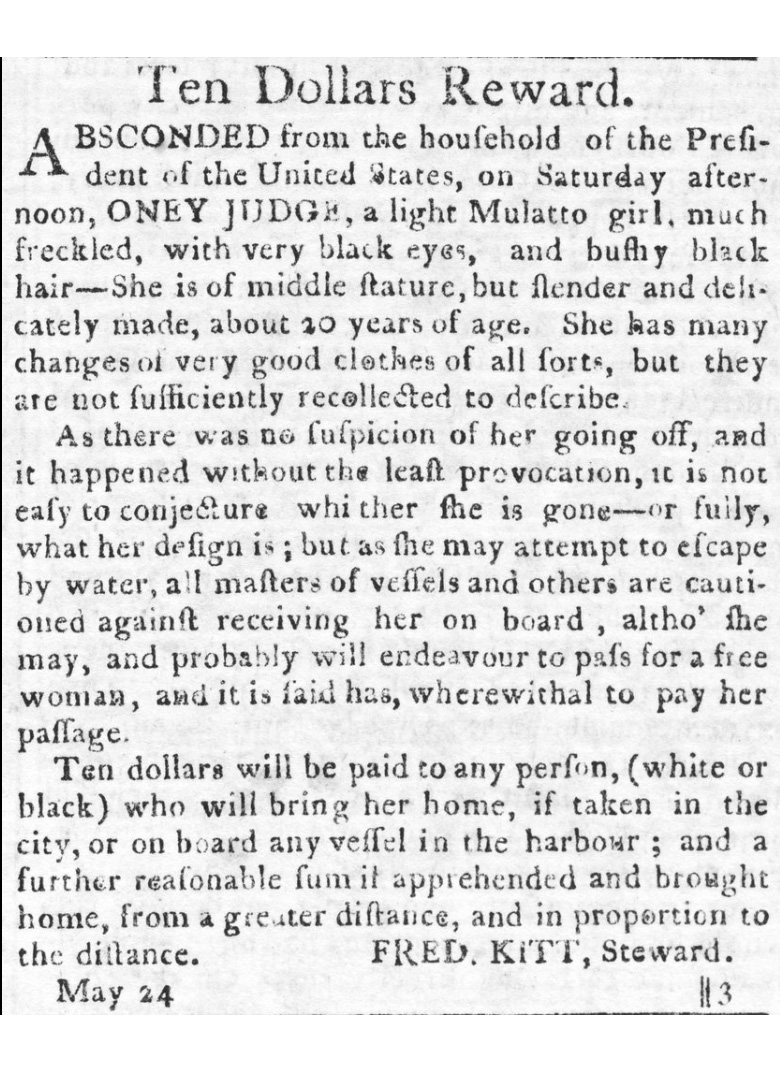
This advertisement appeared in an area paper just three days after Judge’s escape.
COLLECTION OF THE HISTORICAL SOCIETY OF PENNSYLVANIAThough it was fairly common during the post-revolutionary period for enslaved people to self-emancipate by escaping, the risks were high. Recaptured slaves were often brutally punished or sold off into harsher circumstances. And it was rarer for a woman to take such a leap — the vast majority of fugitives were men. But Judge was likely inspired and emboldened by her time in Philadelphia, where more than 5% of the population was free and Black; in the early 1790s, only around 200 enslaved people lived in the city.
“It’s really the first time that Ona and her enslaved companions are surrounded by Black freedom,” said historian Erica Armstrong Dunbar, who spent nine years exhaustively researching Judge’s life for her book, “Never Caught,” after happening across the 1796 ad. “Freedom is contagious.”
Judge would have encountered — and likely befriended — free Black citizens as she accompanied Martha on social visits and errands and even attended the circus. Still, the Washingtons apparently had trouble grasping Judge’s motives. Martha was distraught to lose her maid, whom despite the constant demands placed on her, the couple felt was “brought up & treated more like a child than a Servant.” The president believed Judge was seduced by a “Frenchman.” The runaway ad claimed “there was no suspicion of her going off, nor no provocation to do so.”
Dunbar attributes some of the Washingtons’ bafflement over Judge’s escape to “paternalistic justifications” of slavery, and she said the president must have understood Judge’s yearning to be free. “George Washington had just fought a war about freedom,” she said.

Secrets of the Tombs
Archaeologists at the Kingsley Plantation in Florida shed light on the slaves who lived, worked and died there 200 years ago.
See more ›For years, George and Martha had been moving their enslaved servants out of Pennsylvania and back again, to subvert laws mandating that enslaved people who entered the state should be liberated after six months. The president knew this subterfuge wouldn’t sit well with the public. “I request that these Sentiments and this advise may be known to none but yourself & Mrs. Washington,” he wrote to his secretary, Tobias Lear. A further wrinkle was that the president didn’t actually own Judge; her mother, Betty, was connected to Martha’s first husband’s estate, which meant that if Judge escaped, Washington would have to compensate his wife’s heirs for the loss.
In Portsmouth, Judge found lodging through a network of allies and took a job as a domestic laborer. In January of 1797, she married Jack Staines, a free Black sailor, and they boldly published their wedding announcement in the newspaper. Before long the couple had a daughter, Eliza. They would eventually have another daughter and a son.
Washington made at least two attempts to apprehend Judge. After she was spotted by a friend of Martha’s granddaughter Nelly in late 1796, the president asked his Treasury secretary, Oliver Wolcott Jr., to contact Portsmouth’s customs officer, Joseph Whipple, who devised to lure Judge with a false job offer. When Judge came to inquire, Whipple’s probing questions made her suspicious, and he admitted his motives and tried to convince her to return to the Washingtons. To placate him, Judge agreed to meet him later and board a ship, but she never showed.
Three years later, Washington asked Martha’s nephew, Burwell Bassett Jr., to try again. When he arrived at Judge’s door, Bassett promised that if she returned with him to Mount Vernon, she’d be granted freedom. Judge stood her ground. “I am free now and choose to remain so,” she told him, according to an interview she gave to the Granite Freeman, an abolitionist newspaper, in 1845. Flustered, Bassett left but plotted to return and seize Judge and Eliza by force. But someone tipped off Judge — possibly Sen. John Langdon, whom Bassett was staying with, but whose views on slavery had softened. By the time Bassett circled back, Judge had hired a horse and carriage and fled to Greenland, New Hampshire, 6 miles away. “For me, it’s so extraordinary,” said Yancey, “because here’s this woman, she doesn’t have a lot of power, and she’s outsmarting the most powerful man in the country.”

National Parks
You can read this and other stories about history, nature, culture, art, conservation, travel, science and more in National Parks magazine. Your tax-deductible membership donation of $25 or more entitles…
See more ›Washington died in 1799, and in the 1845 interview Judge said “they never troubled me any more after he was gone,” though her path was far from smooth. She remained in New Hampshire with her husband and children, doing odd jobs for scant pay. After Staines’ death in 1803, the household’s finances were even more precarious, and Judge moved in with a free Black family, the Jacks. She outlived her three children, and she probably never reunited with her relations in Virginia, including her half-sister Philadelphia, who was given to Elizabeth Parke Custis Law in her place. (She was eventually freed by Custis Law.)
Amid the hardships, Judge became literate and found solace in the Christian church. She would remain a fugitive until her death in 1848 at around age 74, but in the Granite Freeman interview, Judge said she had no regrets about the life she lived. “No, I am free,” she said, citing the conditions that allowed her to educate herself, “and have, I trust, been made a Child of God by the means.”
Dunbar said that while it may complicate our ideas of figures like the Washingtons, presenting the “hidden stories” of people such as Ona Judge can give the public “a more holistic and accurate depiction of this nation,” which in turn allows them to better understand their country and themselves. “All it can do is enrich the history,” she said. “It doesn’t subtract anything, it doesn’t remove anything. It’s additive.”
About the author
-
 Dorian Fox Contributor
Dorian Fox is a writer and freelance editor whose essays and articles have appeared in various literary journals and other publications. He lives in Boston and teaches creative writing courses through GrubStreet and Pioneer Valley Writers' Workshop. Find more about his work at dorianfox.com.

-
Press Release
Atrocious Reported Changes to the ESA Could Threaten Extinction to Park Wildlife, Wild Nature
"This memo appears to suggest that it’s no longer the purpose of the ESA to ensure animals such as grizzly bears, North Atlantic right whales, or Florida panthers are protected"…
-
Press Release
First Mining Claims Filed in Lands Cut from Bears Ears National Monument
"National park units and their surrounding landscapes are no place for energy development, but outdated laws elevate mining above all other uses on these lands. We will continue to fight…
-
Press Release
Groups File Injunction to Stop Development at West Potomac Park
“West Potomac Park is treasured green space and we will not stand for the unlawful destruction of public lands that belong to all of us."