Fall 2026
Call to the Wild
An eager pup at Grand Canyon does her very best to prevent humans and animals from mingling.
Not far from the historic El Tovar Hotel in Grand Canyon National Park, one of the park’s newest workers starts her days with a walk around her spectacular backyard. By 7 a.m., she’s on the job with the park’s wildlife biologist, Brady Dunne. Her mission? Scare away the elk.
Blue is an almost 2-year-old Catahoula leopard dog, a leggy and lean 50-pound pup specially trained to haze the animals that get too close to visitors — a task she carries out with gusto. In May, she began work as part of the Conservation K9 Pilot Project, an initiative to help park staff reduce human-wildlife conflicts.
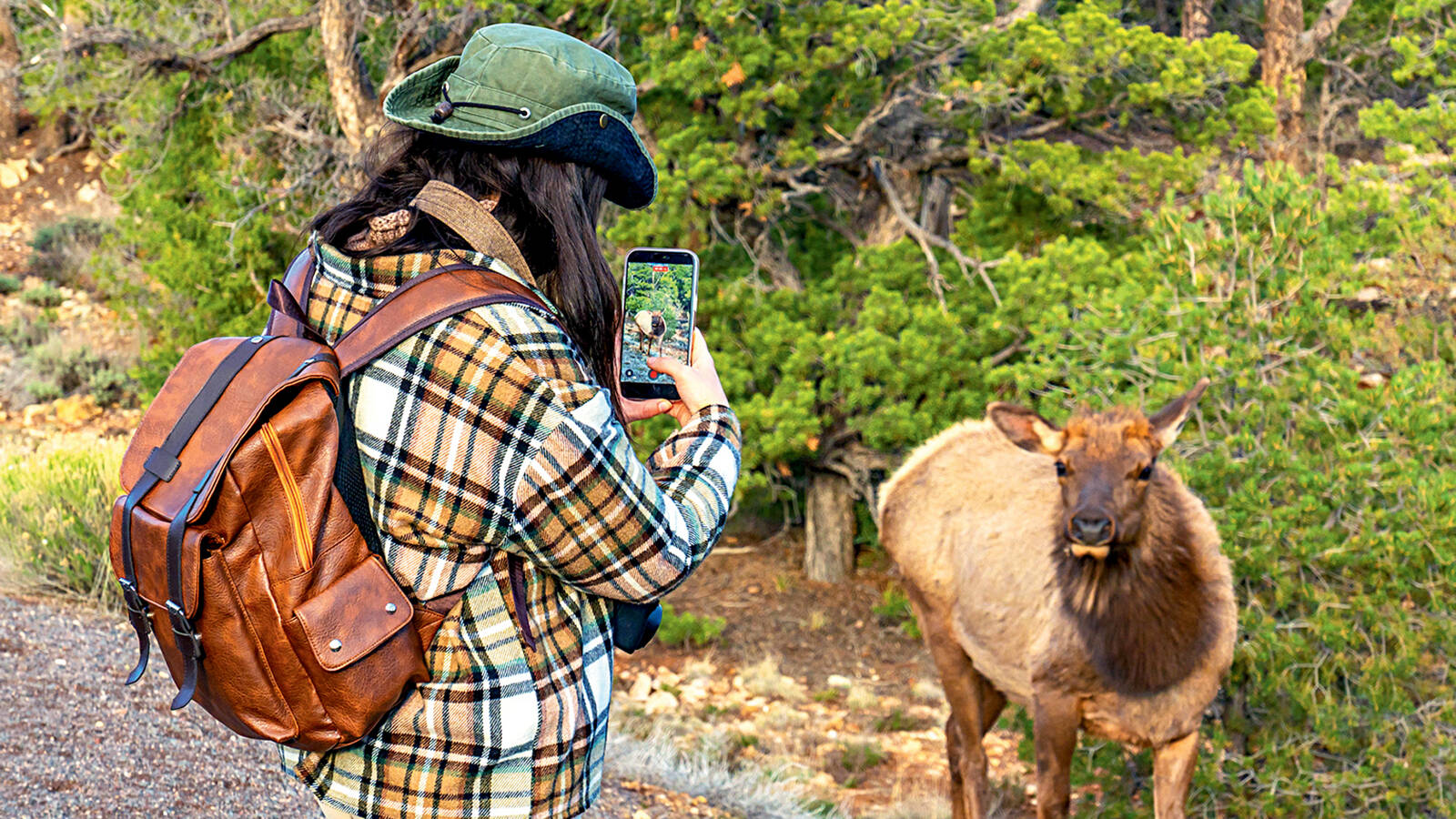
About 300 to 400 elk regularly hang out at the Grand Canyon Village on the South Rim — a high-density area that is visited by more than 4 million people a year. “Elk sit in front of the El Tovar with their calves, surrounded by tens or hundreds of people taking selfies,” Dunne said. “It’s fine most of the time, but when it’s not, these animals are extremely fast and dangerous.” (Park staff ask visitors to stay at least 75 feet from deer and most other wildlife, 100 feet from elk, and 150 feet from black bears.)
Dunne started working at Grand Canyon in 2024 and found that he was responding to a lot of calls about elk — whose population has been growing in the last 20 years. “Many of them are extremely habituated,” he said. “If you can pet a wild animal, that’s a problem because people don’t realize it’s not a tame animal.”
Dunne has a long history with wild creatures. He spent more than 20 years in the Rocky Mountains studying large carnivores (think grizzly bears, cougars and wolves). After collecting more than 60,000 hours’ worth of field data, he shifted toward wildlife management, specifically focusing on researching and addressing conflicts between visitors and resident animals. That has landed him in some rather delicate situations — including being charged by a grizzly at Yellowstone when he was trying to guide the bear away from cars and people.
Park specialists like Dunne have limited options when trying to separate wildlife and humans. Public outreach is important, but training millions of visitors to stay away from wild animals (especially in the smartphone era) is unrealistic. And relocating or even killing animals that pose a threat to visitors isn’t anyone’s first choice, though it’s sometimes necessary. So Dunne, who considers himself a wildlife problem solver, started thinking creatively about how to dishabituate the animals.

Working Like a Dog: See How Pups Help Park Rangers in These 12 Unusual Jobs
From sniffing out turtle eggs to keeping mountain goats out of parking lots, four-legged rangers carry out many duties that help preserve national park resources and make sure visitors have…
See more ›“I thought, if I were an elk, what would I be most afraid of?” he said. That led him to buy Blue, whom he describes as a herding dog with grit and a strong prey drive. Blue won over the right humans, and the Grand Canyon Conservancy offered to fund the program, including basic obedience training at Wind River Canine Partners in Montana and sheep and cow herding training in Arizona. Then she learned from Dunne how to patrol on a 3-foot leash, using controlled barking and herding pressure to encourage elk to retreat to their natural habitats.
To be sure, the goal is not to drive animals out of the park, said Mindy Riesenberg, a spokesperson with the conservancy. “The elk are part of the experience. We want them there. We just don’t want them getting too close to the visitors.” The objective, she said, is to train the elk not to return to developed areas after they come face to face with what they might think is a wild wolf. “Over time, they will learn.”
When Dunne gets a call about elk, he goes to the location with Blue and two colleagues who help clear traffic. Dunne said he and Blue get as close as they safely can to the elk, moving away from the crowds of humans. Dunne gives Blue a series of sharp commands (“check it out,” “easy” and “quiet”), including her favorite: “bark.” Blue typically barks for less than a minute, and the elk react as they would to a predator — throwing their heads up and running away. Once they’ve dispersed, Dunne tells Blue to “leave it” (her least favorite command) before giving her a treat, pets and plenty of praise. During peak seasons (calving in the spring, rutting in the fall), they might shoo elk away 15 times a day.
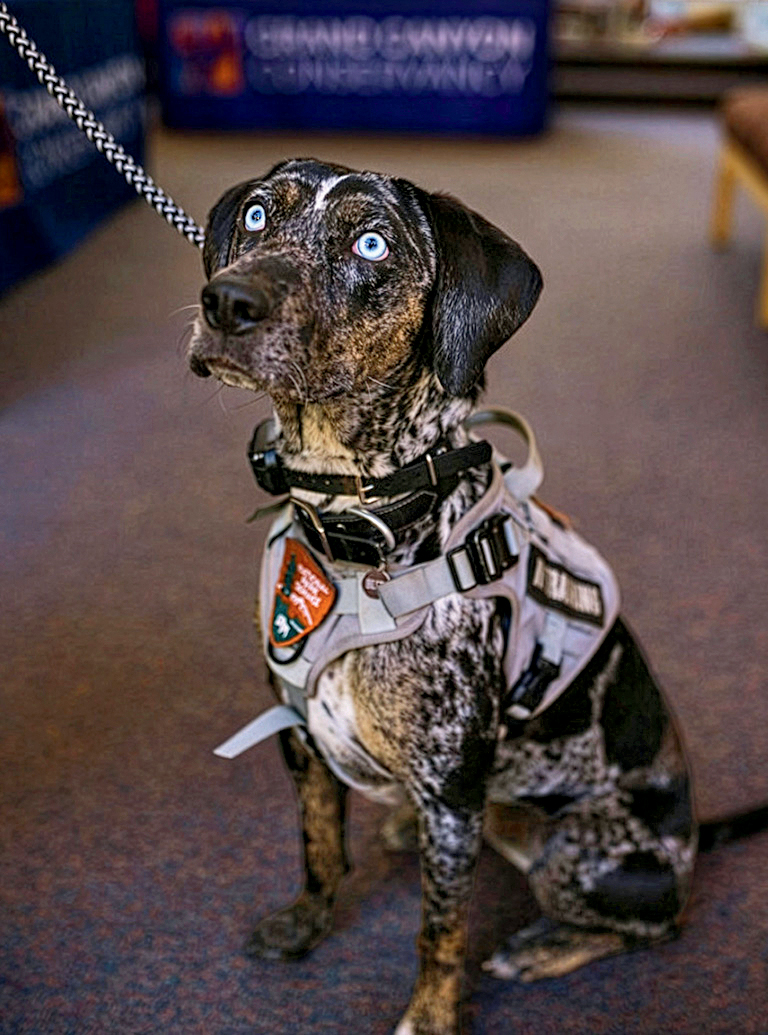
Blue’s favorite command is “Bark;” her least favorite is “Leave it.”
NPSExpenses for the three-year program include Blue’s veterinary care, an ATV to reach remote locations, wildlife monitoring and data analysis. Last year, staff deployed radio collars on nine habituated elk and five habituated desert bighorn sheep to learn how the animals move around the Village and how their behavior changes over time. Dunne said that based on his observations, the program is working — but he won’t know for sure until data show reduced wildlife presence, fewer emergency wildlife calls and fewer hazardous human-wildlife interactions. Also, the human-dog duo just started dealing with bighorn sheep, which typically show up in the Village in late summer.
After Blue’s morning patrol, she joins Dunne in his office, he said, “trudging in like a sulking teenager.” They do a final sweep at the end of the day and then set off on a 2-mile hike on a private Park Service road. Blue chases a ball and runs until, Dunne said, she’s “gassed out.” They return to their stone cottage near the Village, where, with no elk or ball to chase, she finally relaxes.
FEELING BLUE?
Blue isn’t the first wildlife management canine in national parks. At Yosemite National Park, rangers used free-ranging hounds to help with bear issues as early as the 1930s, and the first formal human-bear-conflict working dogs were employed there in 1997. These days, Yoshi, a Karelian bear dog, works with one of the park’s biological science technicians. At Glacier National Park, Bark Ranger Gracie, a border collie, worked from 2016 until her retirement in 2025, helping move bighorn sheep and mountain goats away from cars in a congested area.
Dunne hopes that he and Blue will one day be loaned out to other parks facing habituation issues, such as Grand Teton and Yellowstone. “This is one of the biggest needs, and a really beautiful technique to solve the problem,” he said, “because people love dogs.”
About the author
-
 Melanie D.G. Kaplan Author
Melanie D.G. Kaplan is a Washington, D.C.-based writer. Her first book, "Lab Dog: A Beagle and His Human Investigate the Surprising World of Animal Research," was published in 2025. Learn more at melaniedgkaplan.com.
-
Press Release
Interior Turns Alaska Parks Into Game Farms with Outrageous Hunting Rule
“It’s as outrageous as it is disheartening to again see the Interior Department go along with the state of Alaska’s effort to turn national parklands into de facto game farms."
-
Press Release
NPCA Celebrates Staff Expert's New Book on Blackwell School National Historic Site
A groundbreaking new book co-authored by NPCA's Cristobal Lopez tells the history of Blackwell School National Historic Site, highlighting the experiences of the Mexican American students who attended the segregated…
-
Press Release
Trump Administration Continues to Unlawfully Bulldoze National Mall Parks
“This egregious destruction continues to show how the Trump administration operates as if laws don’t apply. They continue to move forward, disregarding the will of the American people for which…