Fall 2026
Rock of Ages
Great Sand Dunes National Park’s strangely shaped stone artifacts had stumped researchers for decades until an archaeologist dared to tap on them.
In her Longmont, Colorado, home one April 2013 evening, Marilyn Armagast Martorano was about to do something nearly unthinkable for an archaeologist: tap on artifacts that were likely thousands of years old. She placed pieces of foam under the elongated stones from Great Sand Dunes National Park and Preserve’s museum, which she had to return to the park the next day. Then she grabbed one of her daughter’s percussion mallets and struck — gently — one of the stones. Instead of the expected dull sound, a crystalline, musical note reverberated across the room, giving Martorano the shivers.
“I just remember tapping them and thinking, ‘Oh, my God! They play!’” Martorano said. “It was shocking.”
In that moment, Martorano solved a mystery that had perplexed archaeologists in the area for decades. Fred Bunch, the park’s chief of resource management and a childhood friend of Martorano, said the assumption had been that the main function of the artifacts another park staffer had dubbed “French baguettes” was utilitarian and had to do with food or survival. “All these people came up with ideas. Maybe it was this, maybe it was that,” he said. “It wasn’t until Marilyn started her research that we realized, well, this is something totally different.”
Martorano identified these strange objects as lithophones, or portable musical instruments made of rock. Her discovery — the result of years of collective research and a bit of luck — has led museum curators across the region to take another look at similar pieces in their collections to figure out whether those too are lithophones. It has also inspired concerts and musical compositions. What’s more, it has provided new insights into the culture and musicality of the people who lived around Great Sand Dunes thousands of years ago, said Adrienne Anderson, a retired National Park Service archaeologist with decades of experience in the region.
That musicality was inescapable as Martorano played a set of lithophones for me when I visited her in March. On a couple of plastic folding tables, she had set out five lithophones, along with an ordinary piece of sandstone, a mano (a stone artifact used to grind food), a bit of petrified wood and a stone with natural ringing qualities from the shore of a lake near Rocky Mountain National Park. (“This isn’t an artifact,” she said. “I just found it.”).
These lithophones were not from the Great Sand Dunes collections — they were on loan from History Colorado, a network of museums — but they were similar to those in size and shape. Their lengths ranged from perhaps 1 foot to 2 feet, and their forms, likely achieved through careful pecking using other rocks as tools (one was adorned by faint zigzagged lines) were those of elongated cylinders tapering at both ends. They were made of especially dense rock like granite or basalt.
The lithophones were not resting directly on the table; instead, Martorano had placed them on a looping rope so that each lithophone was in contact with the rope at two strategic spots. The reason, she explained, has to do with the way soundwaves travel through a lithophone and meet at two points called nodes. Strike a lithophone at one of these nodes, and the sound will be dull. Conversely, resting a lithophone on points other than the nodes will impede the path of the soundwaves and muffle any note it could produce.
Martorano grabbed a pair of mallets like the one she had used for that fateful tap 13 years earlier and first struck the ordinary rock and the mano. The resulting noise was the sort of clank one would expect when hitting a rock with another. Then she hit the petrified wood and the lake stone, producing sharper and clearer sounds. Finally, she tapped on each of the lithophones in quick succession, like a marimba player practicing her scales. It was hard to believe that such delicate notes emanated from pieces of solid rock. “You think of metal bells,” Martorano said.
One who puzzled over Great Sand Dunes’ French baguettes early on was Jack Williams, who was riding his horse there one day in 1938 when he spotted a rock sticking out of the sand. He decided to get off his horse and kick the rock. “I remember when he told me this story,” said Bunch, who has been working at the park for decades. “He said, ‘Hell, I damn near broke my foot!’” While 6 inches of the rock were above the surface, some 18 inches of it were buried.
Williams, who would later work for the Park Service, donated his find to what was then Great Sand Dunes National Monument. Hunting for artifacts was a sort of tradition for locals. While many kept what they found, “over time, people brought into the park and donated to the park more of these strange things,” Anderson said, “until they had a pretty darn extensive collection of them.”
Anderson first came across Great Sand Dunes’ elongated artifacts in the early 1970s. At the time, they were labeled “roller manos” or “pestles.” “They were all given these weird names because people didn’t know what they were,” she said. Because some were found in an area that had been a wetland, one of the theories surmised they could have served as anchors for snares to catch ducks.

Sandbox in the Sky
High-altitude play at Great Sand Dunes National Park and Preserve.
See more ›Martorano, a native of the San Luis Valley who had done groundbreaking research on trees peeled by Native people for nutritional, medicinal or other purposes in Great Sand Dunes, worked on several contracts for archaeological work in the park in the early 2000s. Part of the work involved cross-referencing what she and her colleagues found during their excavations with the artifacts in the park’s museum collections, and she remembers opening a white drawer and spotting some of the enigmatic two-footers. “There were lots of jokes,” she said.
It wasn’t until 2008 that she and her firm began the first formal study of these artifacts. Right away, the prevailing idea that they were tools used to grind food didn’t sound plausible to Martorano because it was clear it would have taken an inordinate amount of time to make them. “Why would you necessarily do that if you just want to beat on pinion nuts?” Martorano said.
Park staff consulted with Tribes associated with Great Sand Dunes, but Tribal members didn’t know about the long stone artifacts or were reluctant to share what they knew, Bunch said. At some point, the park placed ads in local newspapers to connect with people who might have collected similarly shaped objects and would be willing to share them for potential study. Several of those were sent for microscopic analysis, which did identify some elm material — on artifacts a woman had kept under an elm tree in her backyard — but found no evidence of wear consistent with a grinding use. “There were no patterns,” Anderson said. “That was the problem.”
SINGING SANDS
For several years, a few of the objects were sitting around Martorano’s office. “It just bothered me,” Martorano said. “I saw them almost every day, and I kept thinking, ‘What are these things?’”
Then one day, a colleague forwarded her an online video of French researcher Erik Gonthier in which he demonstrated the musical properties of lithophones found in the Sahara. “I kept watching that, and I thought, ‘Wait a minute, his look just like ours,’” she said. “And so I thought, well, you know, maybe I ought to tap on them.”
She did, and the following day, she met Bunch in the small town of Mosca just outside the park to return the artifacts. She asked him if he wanted “to see something cool” and took the stones out. “And she set them out and tapped on them, and, oh, man, my jaw dropped!” Bunch said.
After the exaltation came the hard work. Over the next five years, Martorano thoroughly documented 21 lithophones from Great Sand Dunes and the San Luis Valley and one from the Front Range, counting hundreds of individual peck marks on some specimens. She enlisted the help of a percussion expert to analyze their acoustic properties. Each produced at least two different notes for a total of 57 different notes. Martorano also conducted an extensive review of the literature and discovered the existence of ancient and contemporary lithophones in numerous countries, including Ecuador, Ethiopia and Vietnam. “I started studying them and just got blown away by the fact that they’re found all over the world,” she said.

Lithophones are still being used in various parts of the world, including Vietnam.
©NGUYEN SON/DREAMSTIME.COM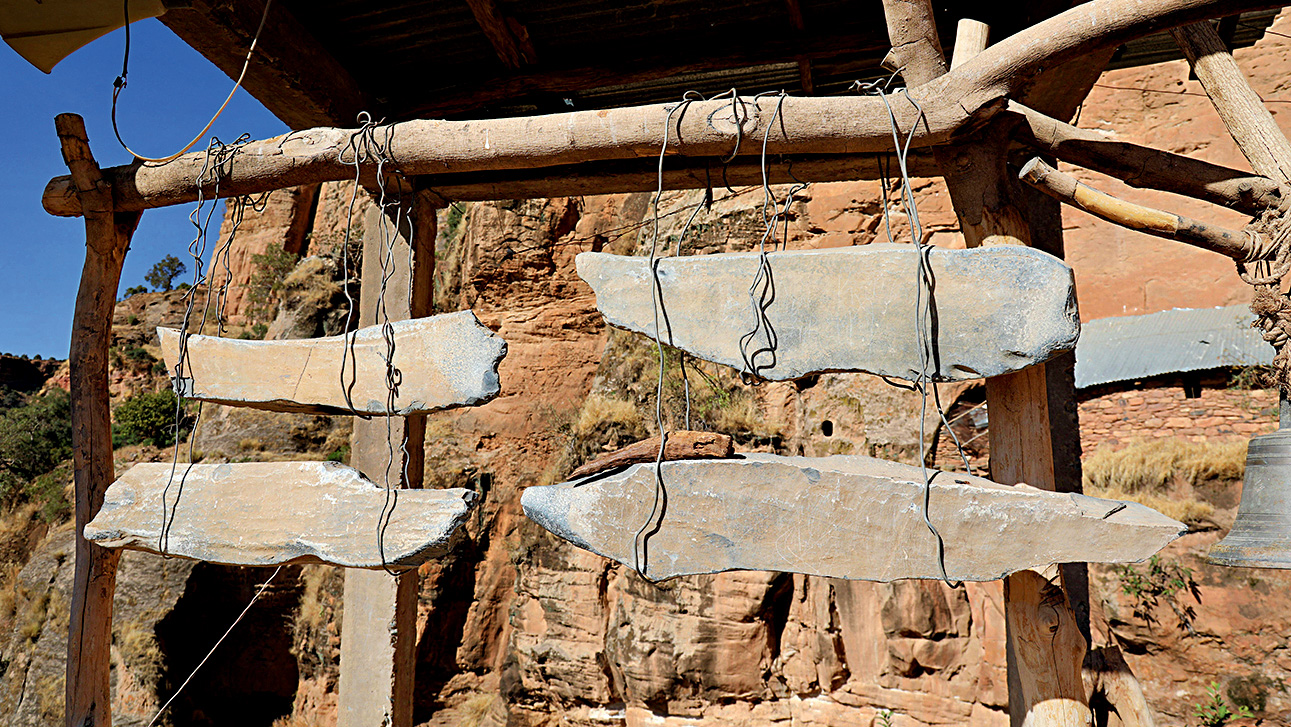
Lithophones of Ethiopia.
©TEWODROSL HAILEMICHAEL/ALAMY STOCK PHOTOThe result of Martorano’s research was a report more than 160 pages long. “When you’re an archaeologist and you present a new idea, you better have some good data,” she said.
Martorano then became a kind of lithophone evangelist and gave as many lithophone presentations to archaeological societies in the region as she could. None of the lithophones she had examined had precise documentation of the archaeological setting in which they were found, and only one came with enough contextual information to estimate its age — about 6,000 years old. Lithophones are artifacts known as ground stones, and those were so common at certain sites that they were a bit of an afterthought for some archaeologists. “I started hearing from people, ‘Oh, we found one of those, but we left it in the field,’” she said. Martorano said she hopes that as archaeologists know what to look for and record lithophone discoveries in situ, they might glean clues to some of the many questions she has: Were they played individually or arranged as a kind of xylophone? What sort of mallets were used? Did the lithophones have a ceremonial or spiritual purpose?
Holly Norton, Colorado’s state archaeologist, said that by considering a completely novel dimension to a long-known type of artifact, Martorano has also encouraged archaeologists to apply creative thinking to their work. “Her ability and her willingness to ask questions that are kind of outside what are the typical confines of archaeology I think give other people the permission to do the same,” she said. “And I think we need that more than ever. We need people asking new questions, and we need people looking at things in a new way to really understand the past.”
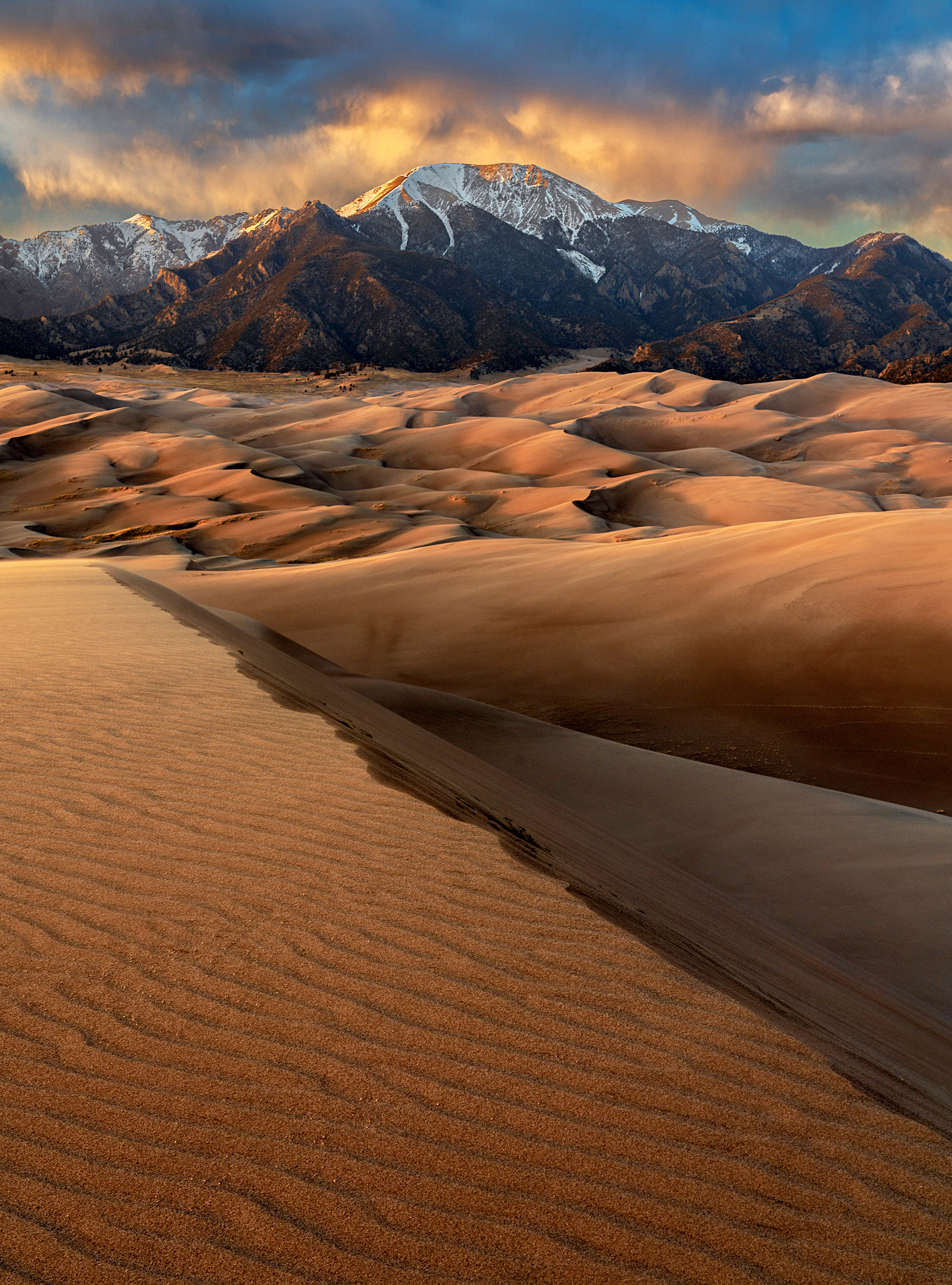
Martorano said she’d like for the lithophones to be played one day near the dunes, a setting known for its unique acoustic properties.
©DANIEL FORSTERMartorano’s work has spurred other types of creativity. Michael Udow, a composer in Martorano’s hometown, was inspired to create his own set of lithophones out of granite countertop and compose a concerto that was performed by the Longmont Symphony Orchestra. Nathan Hall, a Denver-based composer, was intrigued as soon as he heard about Martorano’s lithophones. After documenting the notes played by the lithophones that History Colorado had loaned to Martorano, he contacted local Tribal authorities, who had no objections to his playing the instruments. He then linked up with a percussion ensemble. The album resulting from their collaboration, titled “Gentle Worship,” was released last September. Hall, who has an interest in unconventional instruments, said he’d like to think that humans have always had some kind of music. “It just might not sound at all like the music of today,” he said.
Martorano said she’d like for the lithophones to be played one day near the dunes, a setting known for its unique acoustic properties. Meanwhile, she uses her loaned lithophones to educate the public and is in regular contact with museums and collectors to figure out whether some of their artifacts might turn out to be lithophones. In particular, she’s developed a suspicion that the neolithic jadeite axes found all over northern Europe might prove to be musical if only someone dared tap on them. When she accompanies her husband on fishing trips, she takes out a mallet and taps on rocks to see if they ring.
“It’s just one of those things that, you know, it has you, it’s got you,” she said, “and you want to know more, and you want to share it.”
About the author
-
 Nicolas Brulliard Senior Editor
Nicolas is a journalist and former geologist who joined NPCA in November 2015. He serves as senior editor of National Parks magazine.
-
Press Release
Interior Turns Alaska Parks Into Game Farms with Outrageous Hunting Rule
“It’s as outrageous as it is disheartening to again see the Interior Department go along with the state of Alaska’s effort to turn national parklands into de facto game farms."
-
Press Release
NPCA Celebrates Staff Expert's New Book on Blackwell School National Historic Site
A groundbreaking new book co-authored by NPCA's Cristobal Lopez tells the history of Blackwell School National Historic Site, highlighting the experiences of the Mexican American students who attended the segregated…
-
Press Release
Trump Administration Continues to Unlawfully Bulldoze National Mall Parks
“This egregious destruction continues to show how the Trump administration operates as if laws don’t apply. They continue to move forward, disregarding the will of the American people for which…