Spring 2026
A Fort’s Tale
St. Augustine and Castillo de San Marcos National Monument played a vital role in the Civil Rights Movement of the 1960s. The park is now working to tell this little-known story.
The flyers circulated through the Black neighborhoods of St. Augustine. “Come, see, hear,” the leaflets urged in all caps. “Sunday, May 17, 1964 at the ‘Freedom Tree’ on the lawn of the Old Fort.”
At the appointed time, dozens of neatly dressed men, women and children filed onto the grounds of the Castillo de San Marcos National Monument, a 17th-century fort overlooking the Matanzas River in northern Florida. They circled a squat cedar tree and began to sing and pray. Soon, Hosea Williams, a leader of the Southern Christian Leadership Conference, addressed those gathered, exhorting them to remain steadfast in their goal to desegregate St. Augustine.
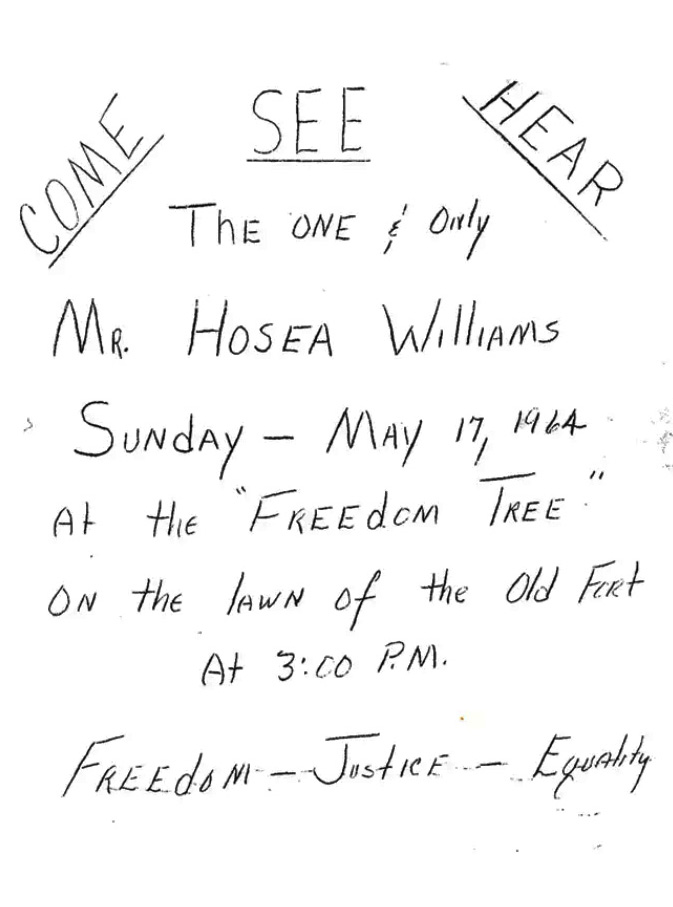
A flyer promoting a gathering at the Castillo’s “Freedom Tree.“
NPSThe centuries-old city had been the center of an unfolding national — and international — news story for months at that point, owing to the civil rights drama playing out on its streets. The previous summer, four youths had been arrested for participating in a sit-in and wound up spending six months in jail and reform school. Four others, including the local leader of the NAACP Youth Council, Robert Hayling, had been savagely beaten and nearly burned alive after trying to observe a Ku Klux Klan rally in September. Over Easter weekend, Mary Peabody, the 72-year-old mother of the then-governor of Massachusetts, had been arrested for trying to integrate a restaurant, an event that “drew the nation’s attention to racial conditions in St. Augustine as no other incident had,” according to historian David R. Colburn.
About a month after the May 17 gathering on the Castillo’s grounds, the U.S. Senate passed the landmark Civil Rights Act. The timing was likely not a coincidence given the spiraling situation in Florida. On the morning of the vote, a prominent Washington, D.C., newspaper featured a shocking photo of a St. Augustine motel manager pouring acid into the pool where Black youth were attempting to swim as the guests of a paying customer. David Nolan, a historian who moved to the city in 1977, described it to me as “the splash heard ’round the world.” If any senator was wavering, he said, that photo clinched their vote.
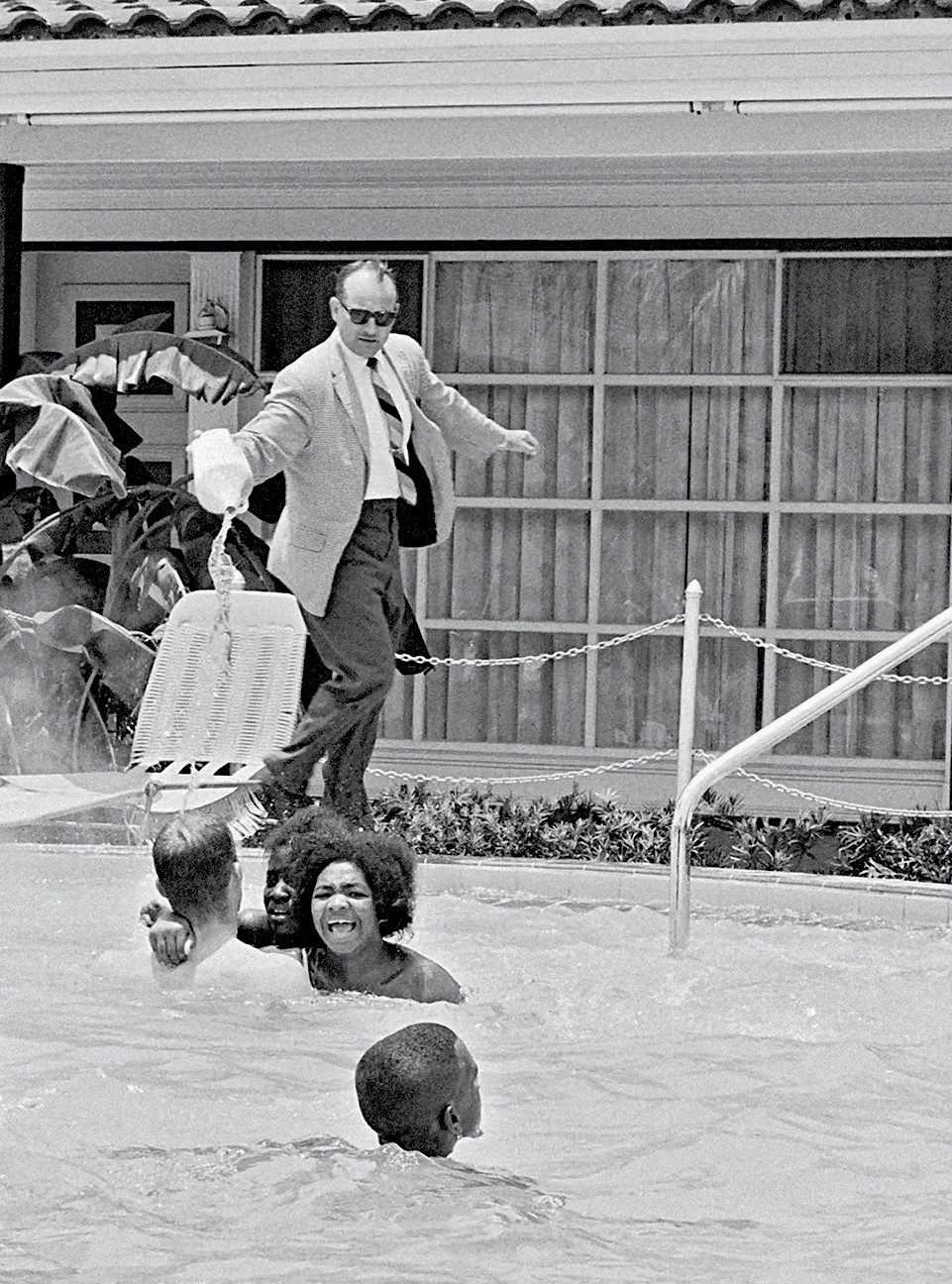
This image of Monson Motor Lodge manager James Brock pouring muriatic acid into a whites-only pool garnered global attention on the day the U.S. Senate passed the Civil Rights Act in 1964.
©AP PHOTO/HORACE CORTStill, this chapter in history remains little known. “St. Augustine has been called the most important place you’ve never heard of in the Civil Rights Movement,” Nolan said. “And part of that is because St. Augustine hasn’t pushed that for a long time.” In fact, many of the Castillo staff were unaware of the Freedom Tree’s significance until about 10 years ago. While more remains to be done, the Park Service has been working to give this critical period of history the attention it is due.
The struggle for civil rights in St. Augustine is nearly as old as the city itself, said J. Michael Butler, a history professor at Flagler College. “Before the more well-known Underground Railroad was established,” he said, “there was an underground railroad in colonial America that led south.” St. Augustine welcomed 11 freedom-seekers in 1687. Six years later, Spain’s King Charles II offered emancipation to those who traveled to Spanish-controlled Florida, adopted Catholicism and served in the militia. Some of those newly free people then contributed to the building — and repeat defending — of the Castillo. In 1738, they established a legally sanctioned free Black community just 2 miles north of town. Generations later, men from St. Augustine served in the United States Colored Troops, and about two dozen were elected to public office in the 19th century.
The city’s Black community was “founded by folks who were fighters,” said Ted Johnson, a former ranger at the Castillo. “And they had resistance and resilience in their blood.”

The Power of Protest
These 7 sites honor the long history of Americans fighting for their civil rights.
See more ›When Black leaders of St. Augustine learned that the U.S. government planned to fund the city’s quadricentennial celebration in 1965 but that no Black community members would be involved or even invited, they decided to act. Requests to form a biracial committee fell on deaf ears, so Hayling and the NAACP Youth Council took aim at tourism, the city’s mainstay.
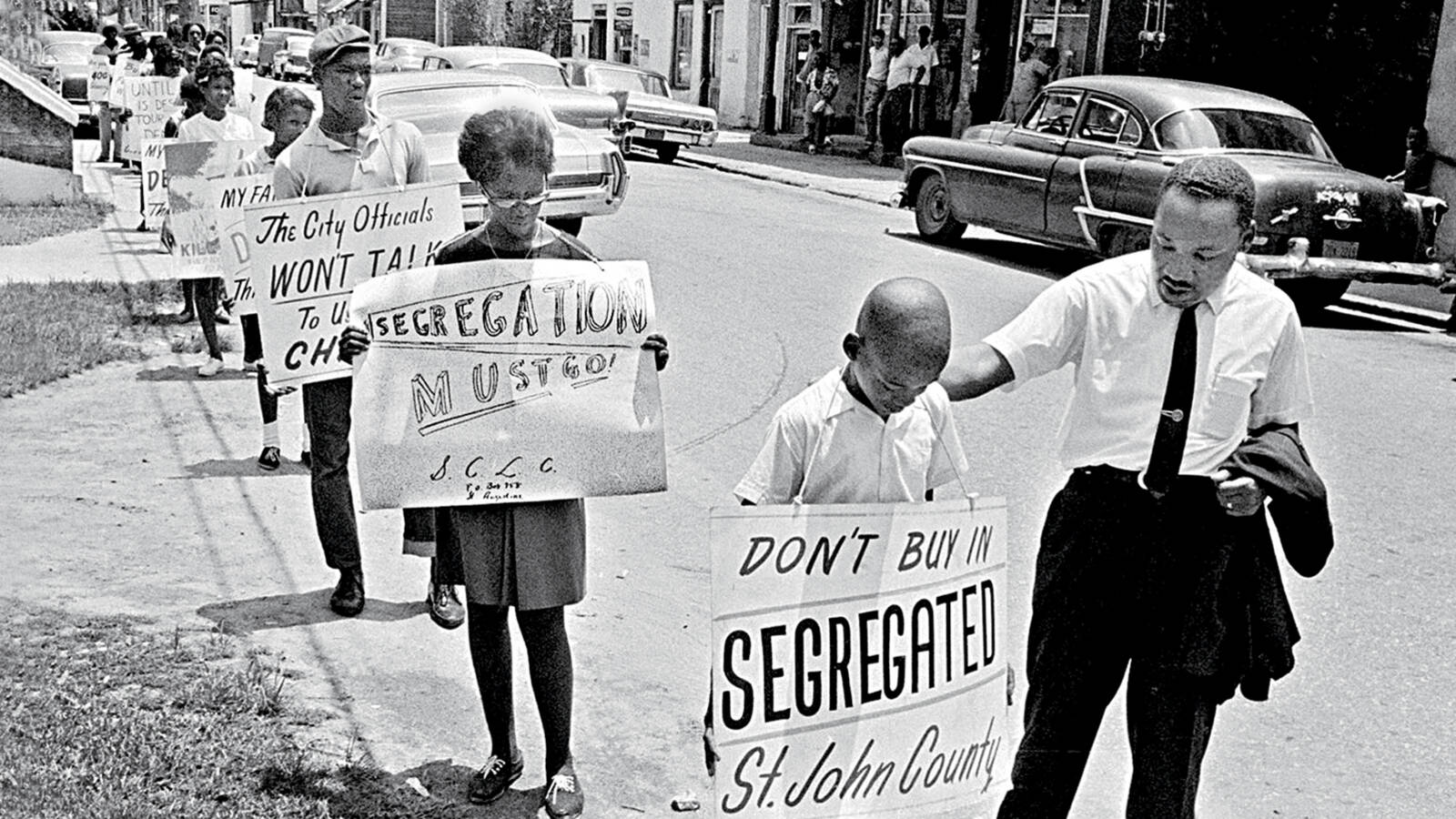
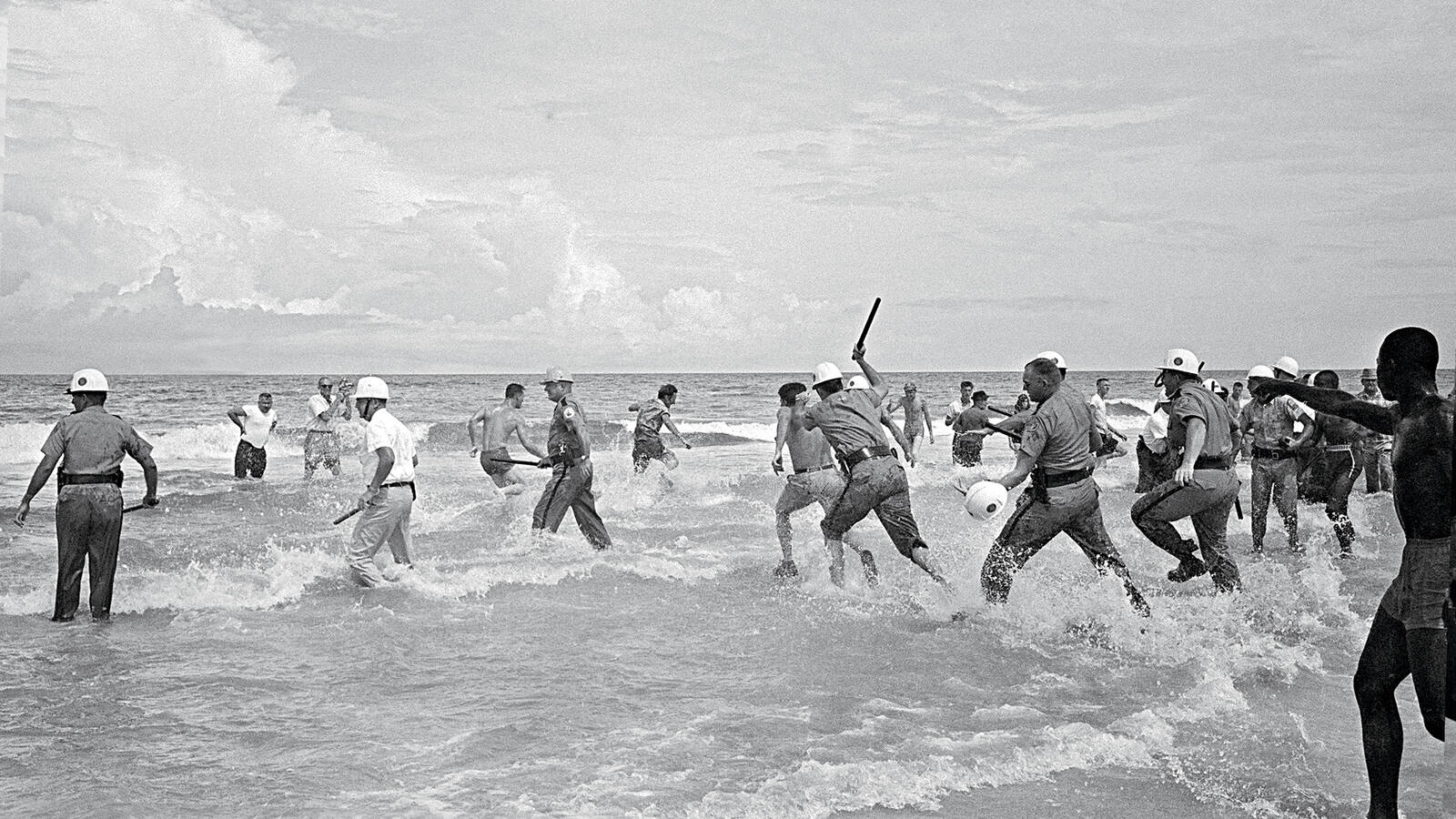
Picketing and sit-ins of local restaurants, hotels and stores began in earnest in the summer of 1963. Children carried signs with words, such as: “Don’t buy in segregated St. Johns County” and “Are you proud of your 400-year history of slavery and segregation?” The tactics diversified to include beach wade-ins, night marches and Castillo rallies once the SCLC came on the scene the following spring. (Though city leaders decried the interference of an outside group, especially one that included Martin Luther King Jr., whom many believed to be a Communist, Butler said local organizers had no other recourse because “the white resistance here was so strident and so violent.” They couldn’t rely on assistance from local law enforcement either, he said, as the chief of police and sheriff were “literally meeting with white supremacist groups every morning” to share information.)
By the summer of 1964, the crisis had reached a boiling point. Some activists had lost their jobs, been threatened with college suspensions or seen hikes in their doctors’ fees in retaliation for their involvement. Hayling’s dog had been killed, and the cottage King had rented for one of his visits had been sprayed with gunfire and then firebombed. Despite the deployment of several hundred Florida State Highway Patrol officers, interactions between the armed mobs and nonviolent demonstrators often escalated from terrifyingly tense to bloody and chaotic in a blink.
FORT AS PRISON
Andrew Young, an SCLC leader who would later become a U.S. congressman and United Nations ambassador, spoke about the night he was attacked on the city’s plaza in a documentary he made, “Crossing in St. Augustine.” “It was the closest I’ve ever come to walking through the valley of the shadow of death,” he said. In a separate film about the campaign, Young explained that the city holds the distinction of being the only one “where the hospital bills [for the SCLC members] were bigger than the hotel bills and the food bills.” Not even the bystanders were immune from the violence. By June, at least 25 journalists and cameramen had been assaulted while reporting. And businesses that integrated had been targeted so effectively that they reversed course.
Though Lyndon B. Johnson signed the Civil Rights Act into law on July 2, the conflict in St. Augustine persisted. “It’s not like everyone was holding hands and skipping through the streets,” said the Castillo’s Johnson. In fact, reprisals from the white supremacist faction were fierce and immediate, from beatings and intimidation to a Molotov cocktail launched into the newly desegregated Monson Motor Lodge. (The business had been the epicenter of some of the most publicized encounters of the movement, including the acid-in-pool incident, as well as the arrests of King and 15 praying rabbis. “We came,” the rabbis wrote, “because we could not stand quietly by our brother’s blood.”) Integration of private businesses ultimately required the intervention of the federal courts. Schools weren’t fully desegregated until 1970, 16 years after Brown v. Board of Education.
It was the closest I’ve ever come to walking through the valley of the shadow of death.
Nolan points to Andrew Young’s return in 2009, documentary crew in tow, as the moment when St. Augustine finally started acknowledging its past. By then, some of the campaign’s iconic landmarks had already been lost. “The idea seemed to be: ‘If we could make the buildings disappear, then this whole history will not have happened,’” Nolan said.
FORWARD THINKING IN FLORIDA
By the time Johnson arrived at the Castillo in 2014, 30-odd plaques identifying the locations of civil rights-era events dotted the town — thanks to ACCORD, a local group — and a monument to the civil rights “foot soldiers” had been erected in the plaza. Nolan supplied Johnson with a copy of the May 17 flyer promoting the gathering on the park site’s grounds and shared a film clip of people singing around the Freedom Tree. That was all the ranger needed to start digging.
Johnson’s time at the fort lasted only a year, but he returned to this project four years later while serving at nearby Timucuan Ecological and Historic Preserve. Before he retired from the Park Service in 2025, he had vastly expanded the Castillo’s online resources detailing the park’s Black and civil rights era history. He also connected with Maude Burroughs Jackson, a longtime activist. In an interview with Johnson, Jackson — who had been 21 in 1964 — spoke about getting arrested on three occasions, making lunch for King and missing her wedding because she was in jail. Jackson also spoke about the group’s use of the fort after a hard day on the streets. “We would meet there just to relax,” she said, “and just reflect on what could be.”
In recent years, staff of the Castillo and Timucuan hosted workshops for area teachers who, Johnson said, were “starving” for this multicultural history. The fort also secured a spot on both the National Underground Railroad Network to Freedom and the African American Civil Rights Network.
Kristine Brunsman, Castillo’s supervisory park ranger, hopes to have an interpretive panel installed at the fort that tells the civil rights story and, one day, she’d like to replace the Freedom Tree, which was likely the victim of a long-ago hurricane. “The Civil Rights Movement,” she said, “is a critical part of not only who we are as a nation, but who we are as a town, who we are as a park.”
The choice to use the fort in 1964 is what Butler finds particularly compelling. Sure, those gathered were criticizing the government for failing to live up to the standards set by the Constitution, he said, but they were also looking to that same government for protection. “Federal property was seen by people who protested as an asylum,” he said. “That idea of the Freedom Tree being a beacon, a place of safety and refuge when all hell is breaking loose is pretty powerful.”
About the author
-
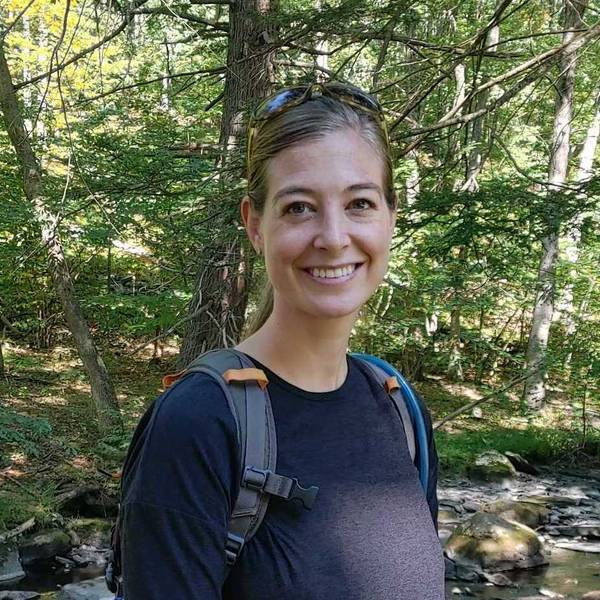 Katherine DeGroff Associate and Online Editor
Katherine is the associate editor of National Parks magazine. Before joining NPCA, Katherine monitored easements at land trusts in Virginia and New Mexico, encouraged bear-aware behavior at Grand Teton National Park, and served as a naturalist for a small environmental education organization in the heart of the Colorado Rockies.
-
Press Release
Groups File Injunction to Stop Development at West Potomac Park
“West Potomac Park is treasured green space and we will not stand for the unlawful destruction of public lands that belong to all of us."
-
Press Release
State of Montana Moves to Drop Yellowstone Bison Suit Ahead of Park Service Analysis
“Those of us who live in Montana understand that bison belong on the land. Bison are woven into America’s conservation legacy and Montana’s history and cultures” - NPCA Greater Yellowstone…
-
Blog Post
FAQ: Border Destruction at Big Bend
The Trump administration destroyed parts of Big Bend National Park in August. We share updates, answer frequently asked questions and share how you can help.