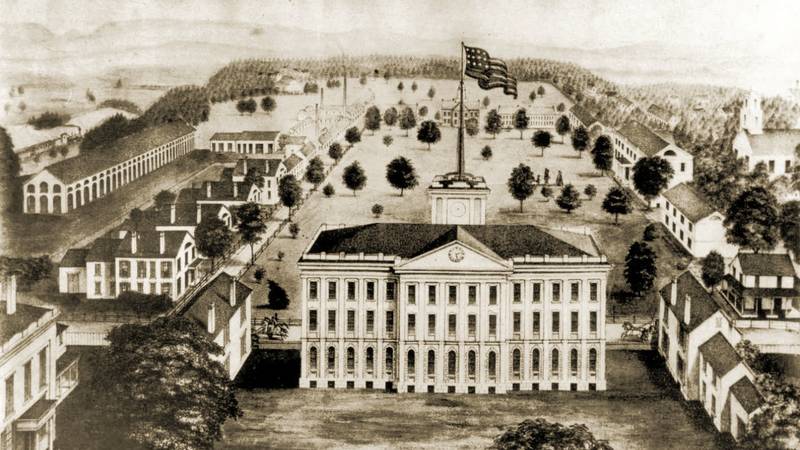
Springfield Armory National Historic Site
For 174 years, Springfield Armory produced the weapons required to equip our military troops for war.
Situated on the Connecticut River, near supply lines but out of range of enemy warships, Springfield was selected as the site of the arsenal for the Continental Army during the Revolutionary War.
In 1794, President George Washington upgraded the Springfield plant to an armory charged with producing flintlock muskets. The Armory perfected mass-production capabilities based on interchangeable parts, the same process now used to build cars and planes.
Over time, the design of Springfield’s weapons changed. The flintlock musket was replaced by the percussion ignition and the muzzle-loaded Springfield rifle used by Union troops during the Civil War.
The Plains Indian Wars 20 years later were fought with breech-loading “trapdoor” rifles. The bold-action repeater debuted with the Spanish-American War.
Most American soldiers during World War I carried bolt-action Springfield Model 1903s. WWII was won with rapid-firing M-1 Garand rifles, which evolved into the fully automatic M-14 used extensively in Vietnam. Midway through that conflict, in 1968, Springfield Armory closed when the Pentagon decided to privatize military weapons production.
At Springfield Armory National Historic Site, you can tour the largest collection of shoulder arms outside Britain, and see how these weapons were made.
WHAT DO YOU THINK?
Post a Comment
Share your park story today. Post your park experiences, recommendations, or tips here.*
* Your comments will appear once approved by the moderator. NPCA staff do not regularly respond to postings. We reserve the right to remove comments that include profanity, personal attacks, or are off-topic. Opinions expressed here do not necessarily reflect the position(s) of NPCA. By submitting comments you are giving NPCA permission to reuse your words on our website and print materials.


abcd123456789
September 25, 2012
Bartskid
May 21, 2012