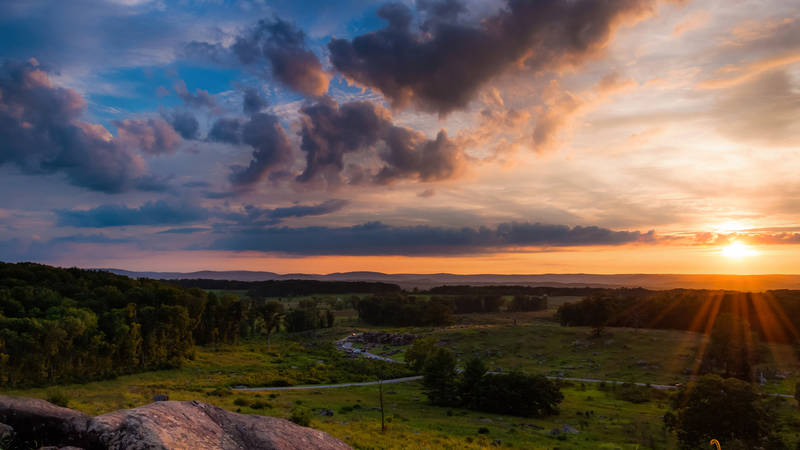
Monocacy National Battlefield
"From every point of view it was heroism."
—Union General Lew Wallace
The battle that occurred on July 9, 1864, near Frederick, Maryland, on what is now Monocacy National Battlefield, became known to history as "The Battle That Saved Washington." On that day, Confederate forces, led by Lt. General Jubal Early, attempted their third and final invasion of northern territory, after they had been repelled by Union forces in the battles of Antietam in Maryland in 1862, and Gettysburg in Pennsylvania in 1863.
In a bold plan to divert Union troops away from their siege of Petersburg, Virginia, General Robert E. Lee sent 15,000 troops under Early to threaten or capture Washington, D.C. Heading East through Harper's Ferry, WV and Sharpsburg, MD, Confederate troops were confronted by Union forces under Major General Lew Wallace (who would write the classic Ben-Hur after the war) at the important railroad junction at the Monocacy River.
Due to warnings of Confederate troop movements from railroad employees, Gen. Wallace was able to position his forces to defend the railroad bridges, but he was outnumbered nearly three to one. After a daylong battle with 1,300 men dead, wounded, or missing, Wallace was forced to withdraw his troops toward Baltimore. The Confederates suffered 900 casualties, but more importantly for the defense of Washington, they lost a day in their march toward the Capitol.
By the time Early's troops arrived in the District of Columbia to begin their assault on Fort Stevens, Union troops had been reinforced by two more divisions. While the battle of Monocacy was technically a Union defeat, General Wallace and his troops, by making a gallant stand and delaying an overwhelming force, had saved Washington, D.C. from Confederate capture.
If You Go
Be sure to visit the park's brand new visitor center and view the upstairs exhibit on the battle. You'll get a great perspective of how the battle affected both soldiers and civilians.
Also stop by the Worthington House, where 6-year-old Glenn Worthington and his family took shelter in their cellar during the fighting. Glenn witnessed the battle through boarded up windows and later was instrumental in getting Monocacy established as a "National Military Park."
—Tracey McIntire
WHAT DO YOU THINK?
Post a Comment
Share your park story today. Post your park experiences, recommendations, or tips here.*
* Your comments will appear once approved by the moderator. NPCA staff do not regularly respond to postings. We reserve the right to remove comments that include profanity, personal attacks, or are off-topic. Opinions expressed here do not necessarily reflect the position(s) of NPCA. By submitting comments you are giving NPCA permission to reuse your words on our website and print materials.


hrsdncng
May 10, 2013
mean green mama
May 8, 2013
Charlie
May 8, 2013
mmonaghan
April 25, 2013
Sandpickle
April 25, 2013
Anonymous
April 25, 2013
Ohio Smith
April 24, 2013
nginsbur
April 24, 2013
cereus
April 24, 2013
Florie
April 24, 2013
David R.
April 24, 2013
Digger
April 15, 2013
ezerasurfer
April 13, 2013
Geode
April 7, 2013
Tamara Hayes
April 4, 2013
themystifier
April 4, 2013
herbs
April 4, 2013
Remy
March 16, 2013
ckatz
March 12, 2013
laura lee p
March 12, 2013
FrB
March 12, 2013
James
March 12, 2013
Anonymous
March 11, 2013
Catking
March 11, 2013
maclaugh
March 11, 2013